Phuket Old Town street food walking tour review
Phuket: Old town street food walking tour
Is the Phuket Old Town street food walking tour worth booking? If you want a structured introduction to Phuket’s Sino-Portuguese heritage district and the Peranakan food culture that distinguishes it from the rest of Thailand, a guided food tour is the most efficient way to cover the ground. In 3-4 hours, a good guide connects the shophouse architecture, the Chinese-Malay culinary fusion, and the individual stall histories in ways that wandering independently does not easily produce. The food is the draw, but the neighbourhood context is what makes it more than just an eating exercise.
| Where | Phuket Old Town — Thalang, Dibuk, Phang Nga and Krabi Roads |
| Cost | around 1,200-2,000 THB / 37-61 USD per person (more for 14-dish version) |
| Time needed | 3-4 hours (4-5 hours for the 14-dish version) |
| Getting there | meeting point on Thalang Road; 15-45 min by Grab from most hotels |
| Best time | evening tours (5-6pm) for cooler temperatures and livelier streets |
Phuket Old Town and why the food is different
Phuket’s Old Town — centred on Thalang Road, Dibuk Road, Phang Nga Road, and Krabi Road — was built largely in the late 19th and early 20th centuries by the Chinese merchant class that grew wealthy from the tin mining industry. The dominant architectural style is Sino-Portuguese, a blend of Chinese shophouse structures with European colonial details that appears in similar form in Penang, Malacca, and Singapore.
The food culture here is Peranakan — a hybrid of Hokkien Chinese and Malay culinary traditions that evolved over generations of intermarriage and ingredient exchange. The result is a southern Thai sub-cuisine that is distinct from the food served in Bangkok or Chiang Mai. It uses more coconut milk, more fermented shrimp paste, more tamarind, and a different spice profile than central Thai cooking. The Old Town’s street stalls and coffee shops preserve recipes that date back four or five generations.
This context is worth understanding before you arrive. The food tour is not just a tasting exercise — it is an edible history of a specific migration and cultural synthesis.
Book the Phuket Old Town street food walking tour on GetYourGuideWhat you will eat: typical tasting stops
Itineraries vary between operators, but most include a selection from the following:
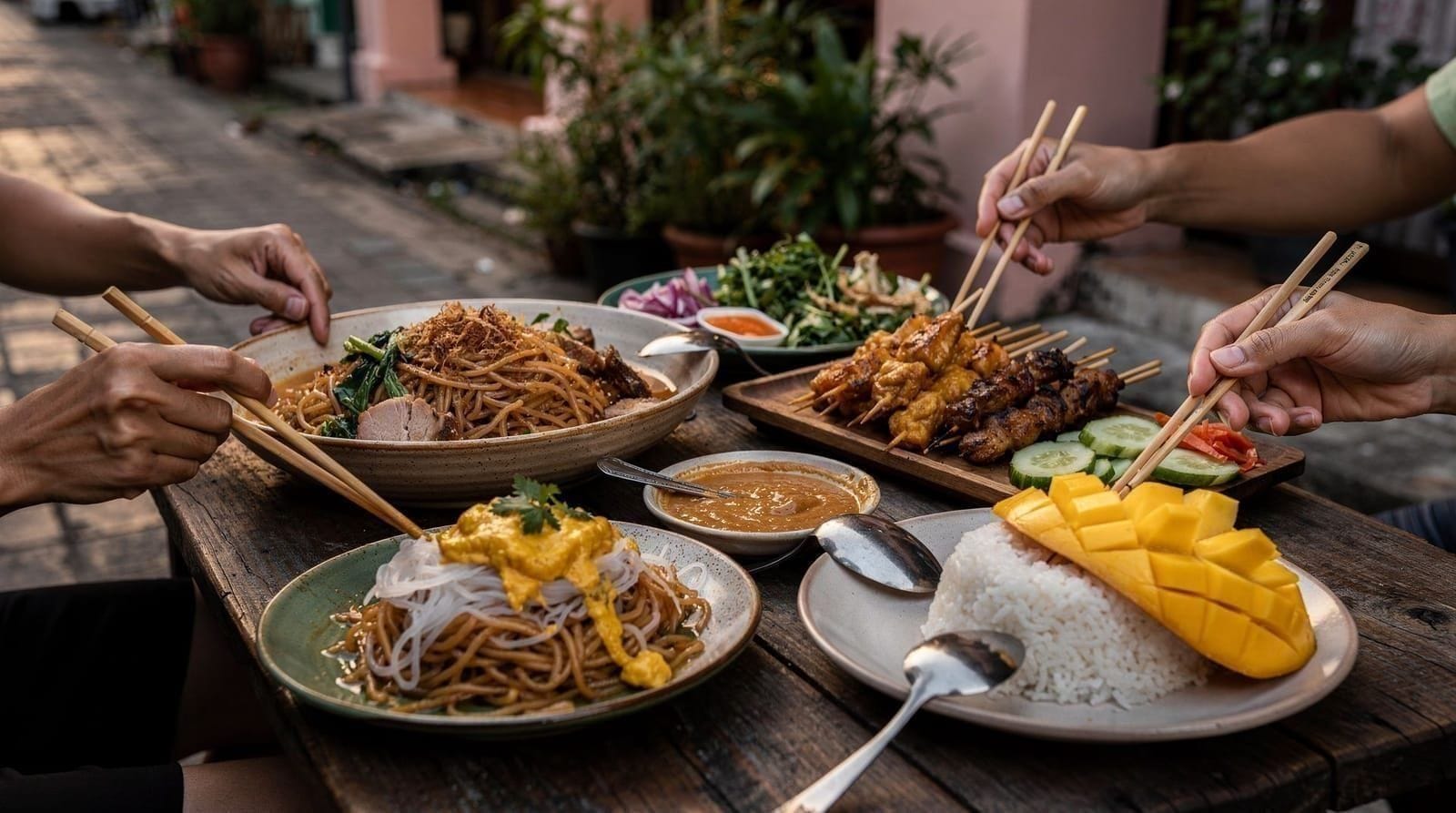
Mee hokkien — thick wheat noodles stir-fried with egg, pork, squid, and a dark sweet-savoury sauce. This is the signature dish of Phuket’s Hokkien community. Good versions have a smokiness from the wok that is difficult to replicate at home.
Khanom jeen — thin fermented rice noodles served with a southern Thai curry sauce. The sourness of the fermented noodle cuts the richness of the curry. Common accompaniments include fresh vegetables, dried coconut, and pickled cucumber.
Lor bah — braised pork belly in a five-spice soy broth, served sliced with hard-boiled eggs and firm tofu. This is street food that appears at morning coffee shops and as a late-night stall item.
Oh-aew — a shaved ice dessert with red beans, grass jelly, and sweet syrup, topped with a scoop of fruit sherbet. One of the most photogenic and distinctive Old Town treats. The shop on Phang Nga Road most associated with this dessert has been operating for several decades.
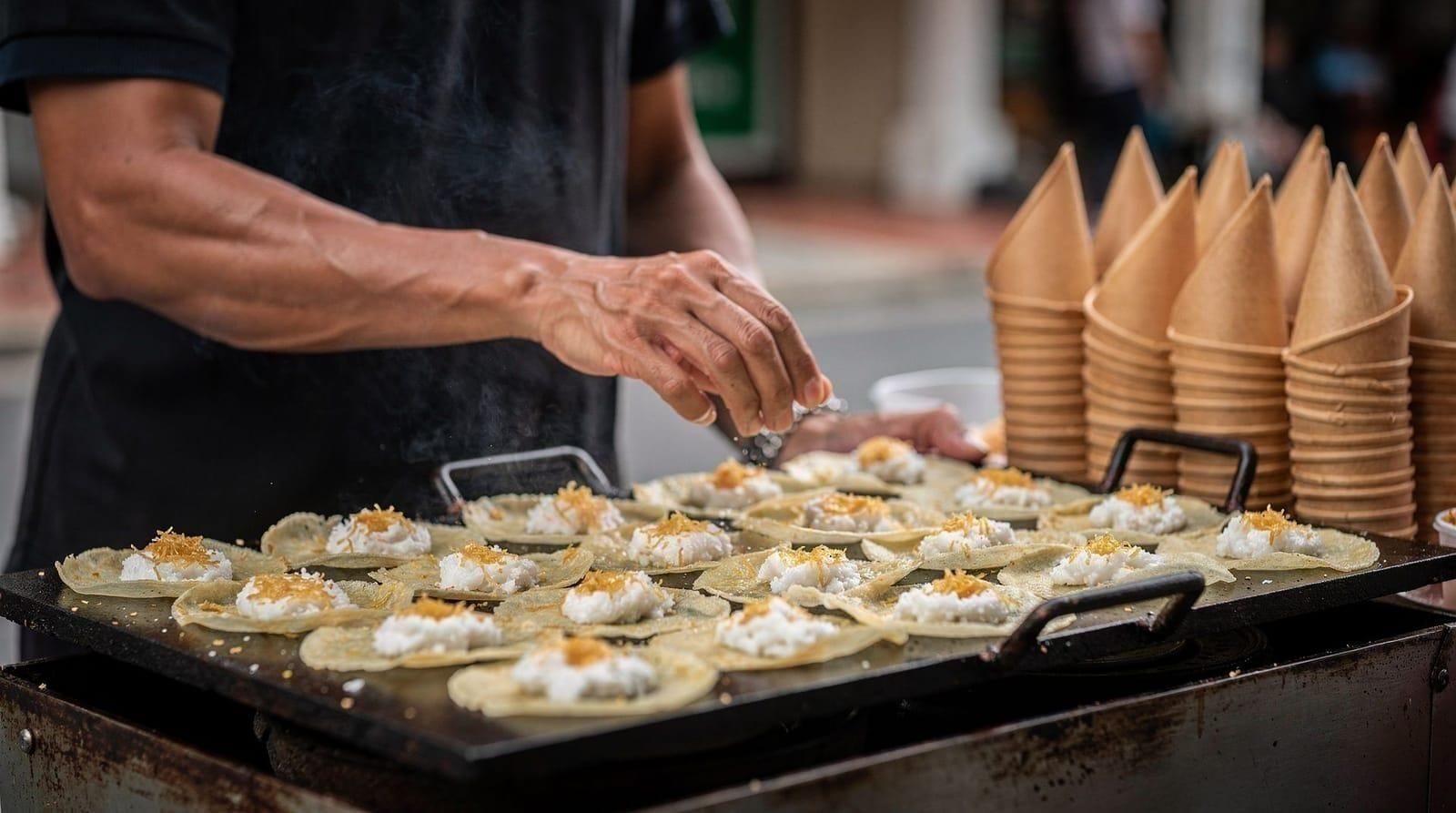
Ah-pong — a small coconut pancake cooked in a cast-iron mould, with a crispy edge and soft centre. Eaten fresh, immediately off the griddle.
Tao hua — silken tofu served warm in a ginger syrup. Gentle and good between spicier tastings.
Khanom buang yuan — a Vietnamese-influenced crispy crepe filled with shredded coconut and eggs. An outlier in the standard Thai-Chinese street food roster, traceable to the Vietnamese merchant community that passed through the port.
Dim sum and Chinese pastries — Old Town’s Chinese teahouses serve steamed and baked dim sum from early morning. Tour stops at these shops vary by timing.
Thai iced tea or cha yen — strong black tea with condensed milk over ice. A palate cleanser between stops.
The 14-dish tour versus the standard version
See the 14-dish Phuket Old Town food tasting tour on GetYourGuideThe 14-dish tasting tour covers more ground and includes dishes that standard tours skip — typically adding a stop at a Chinese coffee shop (kopitiam), a Portuguese-influenced pastry from one of the heritage bakeries, and a second dessert. The extended format runs 4-5 hours rather than 3-3.5 hours, which means more time in the neighbourhood and deeper context from the guide.
The extra time and cost (usually 300-500 THB more per person) is worthwhile if food is a primary interest. If you are covering Old Town as part of a broader sightseeing day, the standard version leaves more time for the street art, shophouse facade photography, and temple visits.
Evening versus daytime tour
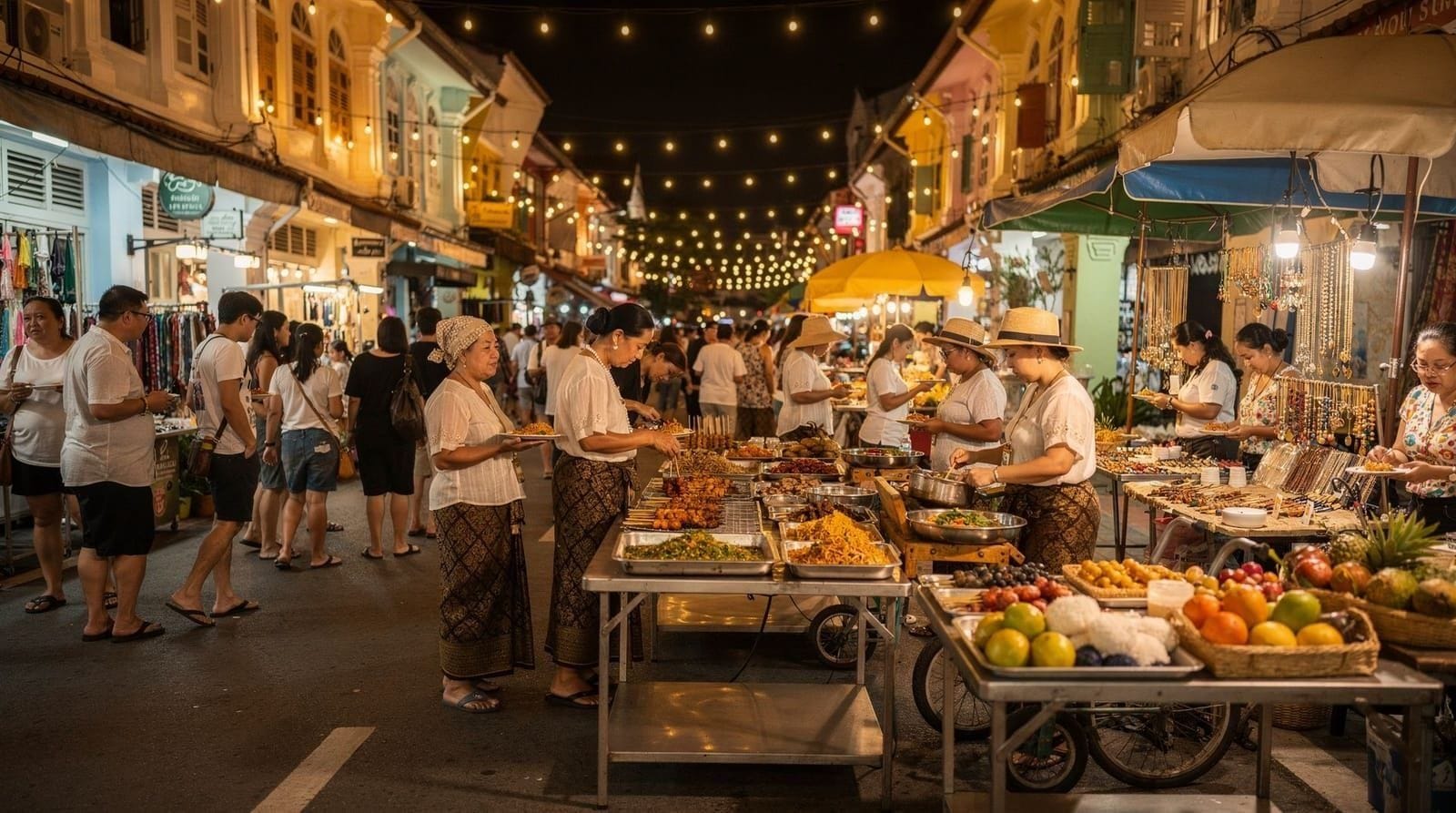
Evening tours (5-6pm start) are measurably better in most respects. The temperature drops from 30-35°C to 28-30°C, which makes walking between stops comfortable rather than wilting. The Sino-Portuguese shophouse facades are illuminated by warm light from the building interiors and decorative lanterns. More stalls are operating — the morning market vendors pack up by noon, and some of the best Old Town spots only start at 4-5pm. On Sunday evenings, Thalang Road’s Night Market adds a festive backdrop.
Daytime tours do have one advantage: the morning market at the Banzaan Fresh Market or the nearby wet market is accessible, which gives context for the ingredients used in local cooking. Some tours that include a “market visit” take this seriously and others treat it as a perfunctory walk-through. Ask your operator which market they use.
The neighbourhood beyond the food
Old Town’s main streets are concentrated enough that 3 kilometres of walking takes you past most of the architectural highlights. The Dibuk Road coffee shops have the most intact historic interiors. Thalang Road has the highest concentration of street art murals, including the widely photographed bicycle mural near the intersection with Soi Rommanee. Phang Nga Road has the formal heritage shophouse rows.
Soi Rommanee, a narrow lane off Thalang Road, is the most photographed block in Old Town — a row of restored blue-and-yellow shophouses now occupied by cafes and boutiques. It is worth seeing but gets crowded in the evening with photographers.
Two Chinese temples anchor the neighbourhood: Jui Tui Shrine on Ranong Road is the more significant (central to the Vegetarian Festival in October) and Put Jaw Chinese Temple is the oldest, dating to the early 18th century. A food tour guide with local knowledge will incorporate one or both into the route.
Compare the Old Town cultural heritage dinner tour on GetYourGuideFor a deeper guide to the neighbourhood itself, the Phuket Old Town guide covers architecture, temples, and the annual Vegetarian Festival in detail. The Phuket food guide and Phuket street food guide cover the broader food scene beyond Old Town.
What’s included
- 3-4 hours of guided walking (4-5 hours for 14-dish version)
- All food tastings as specified (8-14 stops depending on tour)
- One soft drink or tea per person
- Small group maximum typically 8-12 pax
What’s not included
- Additional food and drinks beyond the included tastings
- Alcoholic drinks
- Tips for the guide (50-100 THB per person is standard)
- Transport to/from the tour start point in Old Town
Getting to Old Town from your hotel
Old Town is in the east of Phuket City, approximately 30-45 minutes from Patong by Grab (130-180 THB / 4-6 USD) and 15-20 minutes from Phuket City hotels. Tuk-tuks from Patong charge 300-500 THB. The tour meeting point is typically on Thalang Road or at the Dibuk intersection. Specific GPS coordinates are usually provided at booking.
For transport options in Phuket, the getting around Phuket guide covers Grab, tuk-tuk, and songthaew logistics.
Destinations and guides to combine with this tour
Old Town sits near Phuket Old Town and is conveniently combined with a morning at Big Buddha (10 minutes’ drive) or Wat Chalong. See temples in Phuket for context. If this is part of a short visit, the Phuket in 3 days itinerary positions Old Town well within a tight schedule.
Dietary needs beyond vegetarian
Southern Thai street food leans heavily on shrimp paste, fish sauce, and shellfish, which makes strict allergen avoidance genuinely difficult on a fixed-route tasting tour. Guests with shellfish or seafood allergies should flag this clearly at booking rather than on the day — most guides can substitute at 2-3 of the stops but not all of them, since some dishes (like certain versions of mee hokkien) are prepared in advance by the vendor rather than to order.
Gluten-free guests will find several naturally suitable options (tao hua, oh-aew, most fruit-based desserts) but should expect to skip a handful of noodle-based stops. Halal travellers should note that pork appears in several signature dishes (lor bah, some versions of mee hokkien); ask your operator in advance whether a halal-adjusted route is available, as not all operators offer one.
Choosing a guide-led tour versus exploring independently
A structured tour isn’t the only way to eat well in Old Town — the neighbourhood is compact and walkable, and an independent visitor with a list of recommended stalls (see the Phuket street food guide) can cover similar ground at their own pace and lower cost. What a guide adds is context that’s hard to get otherwise: the history behind specific dishes, introductions at stalls where the vendor may not speak much English, and a route that avoids doubling back through the same streets.
For a first visit to Old Town, especially in the evening when navigating an unfamiliar grid of streets is harder, the guided format removes friction. For a return visit, once you have a mental map of the neighbourhood, going independently with a shortlist of favourite stops is a perfectly good — and cheaper — way to eat your way through Old Town again.