Phuket street food guide: what to eat, where to find it, and prices
Phuket: Old town street food walking tour
What is the best street food in Phuket?
Phuket has a distinctive street food culture shaped by its Hokkien Chinese heritage as much as by mainland Thai cooking — you'll find oyster omelettes, dim sum, and braised pork belly alongside pad thai and som tam. The best eating is concentrated in Phuket Old Town, particularly along Thalang Road and Dibuk Road, and at the Sunday Walking Street market which takes over the Old Town every weekend. Prices at local stalls remain genuinely low — most dishes cost 60–120 THB and a full street food meal for two rarely exceeds 500 THB.
Phuket’s street food scene is not what most visitors expect, and that is genuinely a good thing. The island’s food culture was shaped by waves of Hokkien Chinese migrants who arrived in the 19th century to work the tin mines, and their culinary influence is still everywhere — in the dim sum shophouses of Phuket Old Town, in the braised pork belly stalls on Thalang Road, in the oyster omelettes cooked in blackened woks at dawn. This is a food culture with its own distinct character, separate from both central Thai cooking and the generic tourist Thai food that dominates the beach resort towns. Eating your way through it well is one of the most rewarding things you can do in Phuket that costs almost nothing.
| Where | Phuket Old Town (Thalang/Dibuk Road), Banzaan Market Patong, Rawai seafront |
| Cost | Around 60–120 THB per dish, 150–250 THB for a full meal |
| Best time | Morning (6–10am) for dim sum/porridge, evening (5–9pm) for the rest |
| Don’t miss | Sunday Walking Street, Thalang Road, 4–10pm weekly |
| Cash | Bring small notes — most stalls can’t break 1,000 THB |
Understanding Phuket’s food identity
Before getting into specific dishes and locations, it helps to understand why Phuket street food is distinctive. The province has three main culinary threads running through it simultaneously.
The first is Hokkien-Peranakan Chinese cuisine, the food of the descendants of Fujianese migrants who settled in Phuket from the 18th century onward. This tradition explains why dim sum is sold from Old Town shophouses every morning, why braised pork belly in soy sauce is a local signature dish, and why the standard Thai noodle stall sometimes looks quite different from its Bangkok counterpart.
The second is southern Thai cuisine — spicier, more coconut-heavy, and more reliant on fresh seafood than central Thai cooking. Southern curries use different spice combinations and are often more intensely flavoured. If you’ve only eaten Thai food in Bangkok or tourist restaurants, this will taste noticeably different.
The third thread is the international tourist overlay that exists in Patong and around the main beach resorts — this is not traditional Phuket food, it’s the global menu of pad thai and green curry that tourist operators have learned to produce because it’s what visitors recognise. It’s not necessarily bad, but it’s not what this guide is about.
The best street food is in the first two categories. Finding it means going slightly further than your hotel’s immediate vicinity.
The essential dishes and what they cost
Moo Hong — braised pork belly (80–120 THB)
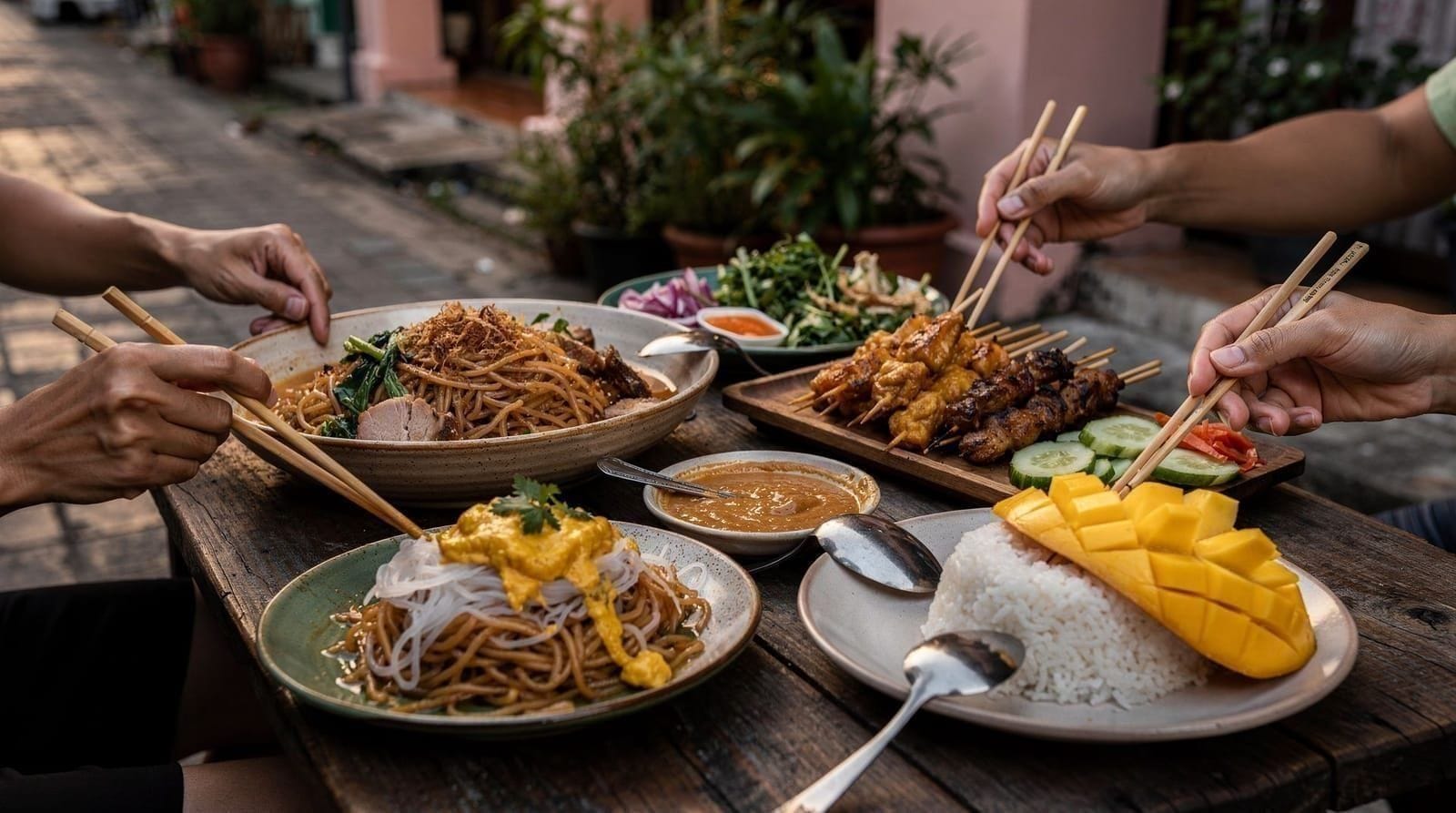
Moo Hong is the dish most firmly associated with Phuket and the one you’re least likely to find easily elsewhere in Thailand. Thick-cut pork belly is slow-braised for hours in a mixture of dark soy sauce, palm sugar, garlic, coriander root, and five-spice until the fat has collapsed into something unctuous and the meat pulls apart. It’s served over white rice or in a claypot, usually with a hard-boiled egg also braised in the same liquid. The flavour is somewhere between Chinese red-braised pork and a Thai stew. Seek this out specifically — it’s a genuine reason to visit Phuket Old Town.
Oh Tao — oyster omelette (60–100 THB)
This dish comes from the Hokkien Chinese tradition and involves fresh or dried oysters cooked in a loose batter made with rice flour, taro, and egg, fried in a very hot wok until crispy at the edges and soft in the centre, and served with a spicy sriracha-style sauce. The taro gives it a slightly starchy, sticky quality that’s unlike anything in central Thai cooking. It’s a breakfast and lunch dish primarily, best found on Thalang Road or at the Old Town morning markets.
Pad Thai — stir-fried rice noodles (60–80 THB)
You know what pad thai is, but the gap between a good street pad thai cooked to order in a howling hot wok and the version produced in a tourist restaurant is considerable. At a properly run stall you’ll see the noodles going into the wok dry, the egg cracked in fresh, the bean sprouts added at the last minute so they still have crunch, and the whole thing assembled in under two minutes. Cost: 60–80 THB at a local stall versus 150–250 THB at a beachfront restaurant for something that’s been sitting in a warming tray.
Kanom Jeen — rice noodles with curry (40–70 THB)
A southern Thai breakfast staple: thin, slightly fermented rice noodles served with a variety of curry sauces ladled alongside. You choose your sauces from a selection — typically a fish-based yellow curry, a chicken curry, and often a spicy green option — and pile them over the noodles yourself. Very popular in the mornings, largely gone by noon as the fresh noodles sell out. The southern Thai version uses a more complex spice blend than you’ll find in the north.
Khao Tom — rice porridge (50–70 THB)
A gentle, forgiving breakfast dish: soft-cooked white rice in a light broth, served with a selection of garnishes including fried shallots, ginger, spring onion, and a choice of protein — minced pork, chicken, or soft-boiled egg. This is what you eat when you’ve arrived in Phuket early in the morning or when the heat has flattened your appetite and you need something unchallenging. Available from most morning markets until about 9am.
Khao Man Gai — poached chicken over rice (60–90 THB)
The cleanest, simplest dish on the street food circuit: chicken poached until just cooked in a fragrantly seasoned broth, sliced and placed over rice cooked in the same broth, served with a bowl of the broth on the side, sliced cucumber, and a dark ginger-soy dipping sauce. The quality of this dish depends almost entirely on the quality of the chicken broth. At a good stall, it’s deeply satisfying. Best before 1pm; many stalls sell out.
Roti — flatbread (30–50 THB)
A remnant of the Muslim South’s influence, now ubiquitous across Thailand’s tourist areas. The dough is slapped thin on a flat iron griddle, folded around banana slices and condensed milk, and cooked until caramelised and slightly crispy at the edges. It’s sweet, oily, and very good at 11pm. Savoury versions with egg are available and substantially more filling for the same price.
Satay — grilled skewers (10–20 THB per skewer)
Pork and chicken skewers marinated in turmeric and lemongrass, grilled over charcoal, and served with a peanut dipping sauce and cucumber relish. One of the most democratic street foods — you eat them standing at the charcoal grill, you pay per skewer, and they’re done in under a minute. Don’t walk past a good satay stall without stopping.
Som Tam — green papaya salad (50–80 THB)
Shredded unripe papaya pounded in a mortar with fish sauce, lime, palm sugar, dried shrimp, chilli, and tomatoes. Ask for “pet nit noi” (a little spicy) unless you’ve been eating Thai food for a while and know what you’re doing — a full-strength southern Thai som tam can be genuinely overwhelming. The version sold from a cart is made fresh in front of you, every time.
Dim sum (15–30 THB per piece)
The Hokkien Chinese heritage of Phuket Old Town means the shophouses along Thalang Road and Dibuk Road serve dim sum from early morning. Steamed buns filled with barbecued pork, taro dumplings, turnip cake, and sticky rice parcels are all standard. This is not a restaurant dim sum service — it’s a stack of bamboo steamers at the front of a shophouse, you point at what you want, you hand over 60 baht for three or four pieces, and you eat on the pavement.
Cha Yen — Thai iced tea (30–50 THB)
Thai iced tea — strong orange tea brewed with star anise and poured over ice with sweetened condensed milk — is everywhere, and for good reason in Phuket’s heat. Available from virtually any stall, any time of day. A useful reference point: if a stall charges more than 60 THB for a Thai iced tea, they’ve decided you’re a tourist and priced accordingly.
Pad Kra Pao — basil stir-fry (60–90 THB)
Minced pork (or chicken, seafood) stir-fried at high heat with Thai holy basil, fish sauce, oyster sauce, and bird’s eye chilli, served over white rice with a crispy fried egg on top. One of Thailand’s most eaten everyday dishes and one of the best benchmarks for a stall’s cooking quality — a good version has a proper wok-seared smokiness and real heat. Ask for “kai dao” (fried egg on top) if the vendor doesn’t assume.
Where to eat: the best locations by area
Phuket Old Town
The Old Town is the undisputed centre of Phuket’s street food culture and worth making a dedicated trip to even if you’re based in Patong or Kata. The main streets to know are:
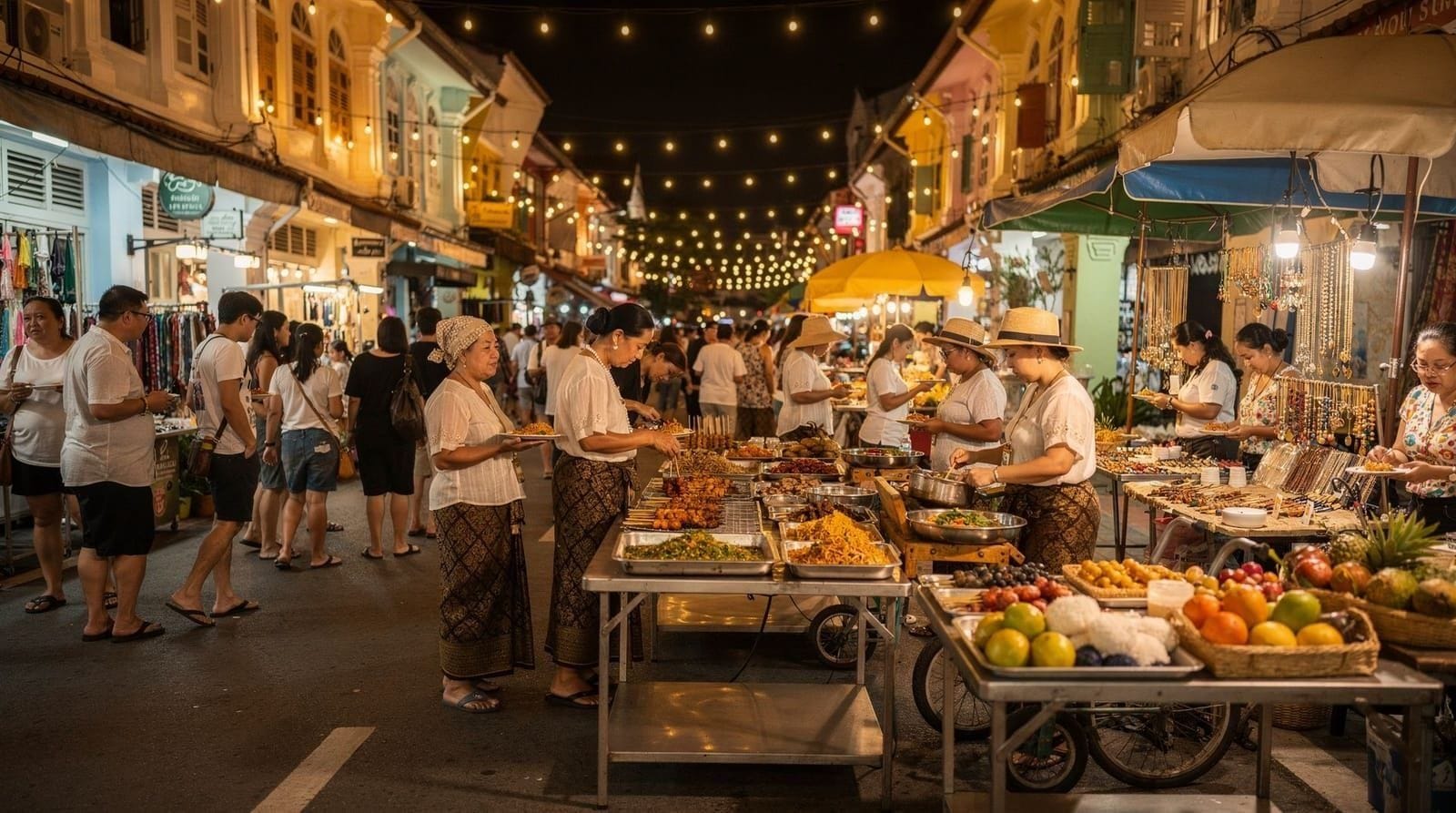
Thalang Road is the backbone of Old Town food. Morning dim sum from the shophouses starts at 6am. Vendors selling Oh Tao set up mid-morning. By evening the street is thick with stalls selling everything from Moo Hong to grilled seafood. On Sunday evenings Thalang Road closes to traffic for the Walking Street, which is the single best food event in Phuket.
Dibuk Road runs parallel to Thalang and has a slightly quieter, more local-facing cluster of morning stalls. Better for breakfast — Khao Tom and Kanom Jeen stalls open at 5:30am and close when they sell out.
Ranong Road near the Ranong Road market has fresh produce vendors in the morning and cooked food stalls in the evening.
The Sunday Walking Street on Thalang Road deserves its own mention: every Sunday from approximately 4pm to 10pm, the street fills with around 100 food and craft vendors. The food quality is higher than at most tourist night markets because the vendor base is heavily local rather than tourist-facing. This is the one weekly event in Phuket that genuinely rewards visiting.
If you’d rather arrive with a guide who can navigate the stalls and explain the dishes — especially useful on a first visit — a structured food tasting tour is one of the better-value experiences in Phuket.
Banzaan Fresh Market (Patong)
Located on Rat-U-Thit 200 Pee Road in Patong, Banzaan is a covered wet market with a cooked food section on the upper floor. It’s the best food option within walking distance of Patong Beach for visitors who don’t want to travel to the Old Town. The ground floor has fresh seafood, produce, and local groceries; the upper floor has stalls serving prepared dishes at local prices. A full meal here costs 100–200 THB versus 300–600 THB at a beachfront restaurant 200 metres away. Open daily from approximately 6am to 10pm, with the cooked food section busiest at lunchtime.
Malin Plaza (Patong)
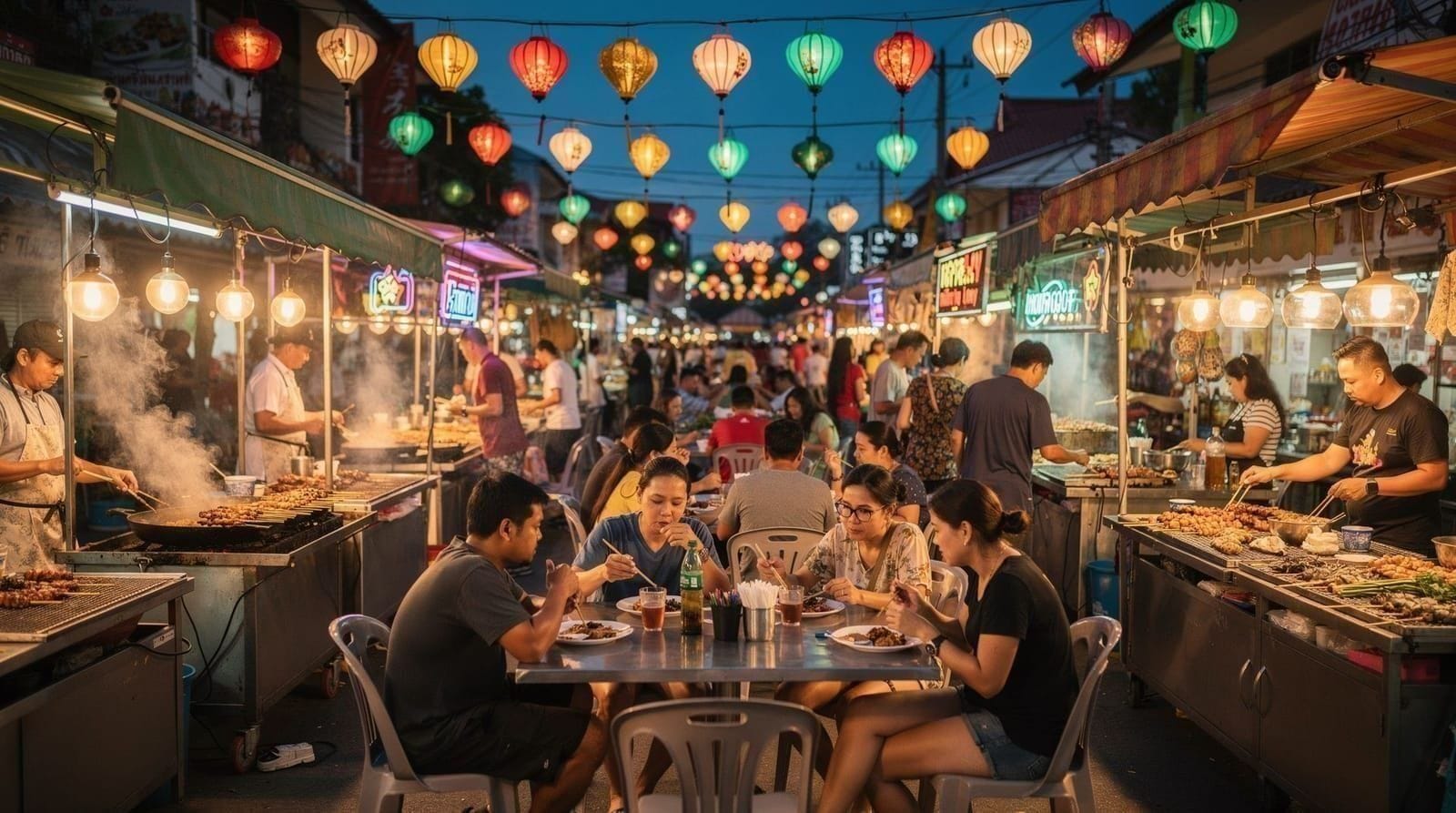
An evening food market on Thaweewong Road near the south end of Patong Beach. More tourist-facing than Banzaan, and prices reflect that, but the quality is decent and the variety is good. Best thought of as a casual dinner option rather than a serious street food destination — it works well as a low-effort evening meal with cold drinks and a sea breeze nearby.
Chillva Market
Located on Yaowarat Road in northern Phuket Town, Chillva is an evening market (Tuesday through Sunday, roughly 5–11pm) that mixes street food stalls with fashion and craft vendors. The atmosphere is younger and the food is a mix of traditional Phuket dishes and more contemporary Thai-café-style offerings. Less overwhelming than the Old Town Walking Street on a busy Sunday, and worth visiting if you’re based in the Phuket Town area.
Rawai Seafood Market
Rawai at the southern tip of the island has a seafood market on the beachfront where vendors sell fresh fish, prawns, crab, and shellfish by weight. The arrangement is straightforward: you buy from the market, then take your purchases to one of the small restaurants immediately adjacent, which will cook your seafood for a minimal service charge (typically 100–200 THB regardless of quantity). This is one of the fairest-priced seafood experiences in Phuket — the buy-by-weight model makes it transparent in a way that tourist restaurant “market price” menus are not.
Bang Tao local stalls
Bang Tao Beach is home to some of Phuket’s most expensive resorts, but the local food scene is on the main road (Srisoonthorn Road) and the streets behind the hotel perimeter. Walk 200 metres inland from the beachfront and the prices drop by roughly 50%. Local curry stalls, coffee shops, and morning market vendors here cater to the Thai staff who work in the resort complex — which means the food is genuine and the prices are local.
A food tour for context
If this is your first time in Thailand and you’re unsure where to start, a structured walking tour with a local guide removes the uncertainty of navigating unfamiliar stalls and dishes. The southern Thai flavors tour is particularly good for understanding how Phuket’s food culture differs from the Thai food you may have encountered elsewhere.
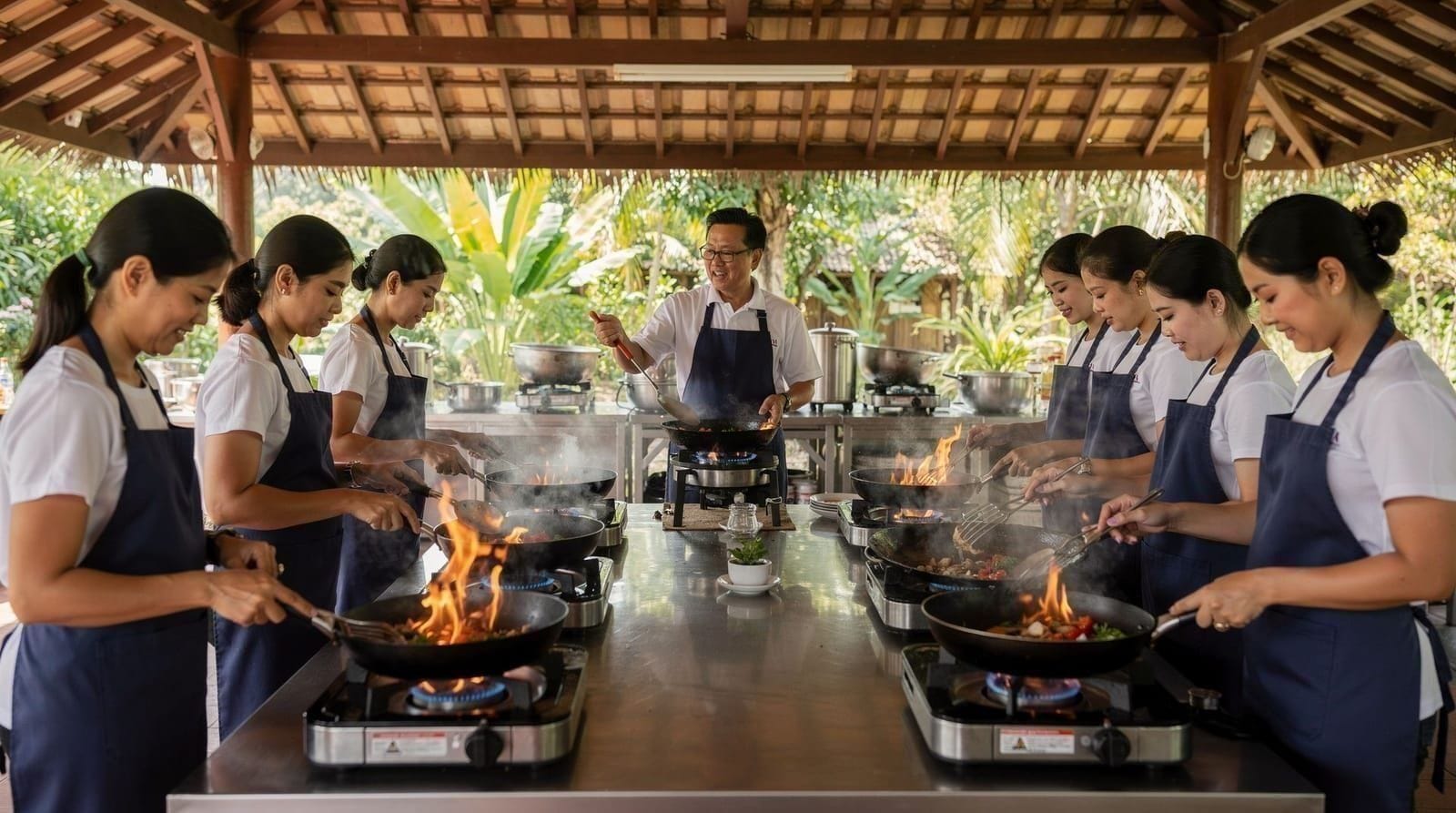
Alternatively, if you want to take some of these dishes home with you, a half-day cooking class that starts with a market visit gives you both the context of seeing ingredients sourced and the practical skills to recreate the dishes yourself.
Practical tips: eating street food well
Look for turnover, not tidiness. A busy stall that’s slightly chaotic is a better sign than an immaculate one with no customers. High turnover means fresh ingredients and food cooked to order rather than kept warm.
Order with your eyes. You don’t need Thai to order at most street stalls — point at what another customer is eating or at the ingredients visible at the front of the stall. Most vendors understand gestures for quantity and spice level.
Manage spice proactively. Southern Thai food is genuinely spicy. Before ordering, the phrase “pet nit noi” (a little spicy) or “mai pet” (not spicy) will prevent you spending the afternoon horizontal. Don’t assume that asking for “not too spicy” will result in mildness by European standards — calibrate your request accordingly.
Cash in small denominations. Bring 50 THB and 100 THB notes. Many stall vendors cannot easily change a 1,000 THB note and will wave you away rather than deal with it. An ATM run before you start eating is useful.
Find the jay flag for vegetarian. The yellow flag with a red Chinese character indicates a jay (strictly vegan/vegetarian, by Buddhist standards) stall. This is particularly common in the Old Town. Outside these certified stalls, assume that fish sauce, shrimp paste, and meat-based stocks are present unless you ask directly.
Water from sealed bottles. Street stall water is invariably sealed bottled water. There’s no reason to be concerned. The ice situation is different from what you might assume — most commercial ice in Phuket comes from centralised factories that use purified water, not from tap sources.
Morning versus evening for freshness. Both are fine, but different dishes are at their best at each. Dim sum and rice porridge are morning foods — by 11am most of the best dim sum will be gone. Som tam, grilled meat, and noodle dishes are available from mid-morning through late evening.
What street food costs: a realistic breakdown
To set expectations clearly: eating street food in Phuket rather than at tourist restaurants will approximately halve your daily food spend without any sacrifice in quality — and for Phuket’s specific speciality dishes, the street stall version is almost always better than the restaurant version.
A typical street food day for one person might look like this:
- Breakfast: Khao Tom with egg (60 THB) + Thai iced coffee (40 THB) = 100 THB (about 3 USD)
- Lunch: Pad Kra Pao with fried egg on rice (80 THB) + fresh coconut (50 THB) = 130 THB (about 4 USD)
- Dinner: Moo Hong over rice (100 THB) + Oh Tao (80 THB) + satay 4 skewers (60 THB) + Cha Yen (40 THB) = 280 THB (about 8.50 USD)
Total: roughly 510 THB, or about 15.60 USD for a full day of eating very well. Compare that to three meals at a tourist beachfront restaurant which would cost 1,200–2,000 THB for equivalent caloric intake with lower food quality.
The Sunday Walking Street: plan your visit
The Sunday Walking Street on Thalang Road in Phuket Old Town is the single biggest food event on the island and worth building an evening around. It runs from approximately 4pm to 10pm every Sunday, with food stalls appearing from around 4:30pm and the main crowd arriving between 6pm and 8pm.
The scale is notable: the entire length of Thalang Road closes to traffic and somewhere between 80 and 120 vendors set up along it. The mix is roughly 60% food and 40% craft and fashion. The food vendors include specialists in Phuket Old Town dishes alongside standard Thai street food, fresh fruit stalls, dessert vendors, and drink sellers.
Practical note: it gets very crowded between 7pm and 9pm. If heat and crowds are a concern, arriving at 5pm is considerably more comfortable. The early evening also has better natural light for food photography, which matters.
The closest parking is on Dibuk Road and the streets behind the Old Town — expect a 5–10 minute walk. A Grab from Patong to the Old Town costs approximately 200–280 THB and takes 20–30 minutes depending on traffic.
Cooking classes: taking the food home with you
If eating great street food has made you curious about how it’s made, Thai cooking classes in Phuket are widely available and cover everything from market-to-table experiences in the Old Town to dedicated sessions focused on southern Thai specialities. The classes that begin with a market visit are particularly useful — watching ingredients purchased in context and then seeing how they function in the dish connects the food culture in a way that recipe books cannot replicate.
Comparing the main street food areas
Not every area delivers the same experience, and knowing what each one is actually for saves a wasted evening. This is a rough guide to what to expect before you commit an evening to any one spot.
| Area | Best for | Typical spend | Crowd level |
|---|---|---|---|
| Phuket Old Town (Thalang/Dibuk) | Full range, Hokkien specialities, best overall quality | 150–250 THB/meal | Moderate, high on Sundays |
| Banzaan Market (Patong) | Convenience for Patong-based visitors | 100–200 THB/meal | High at lunch |
| Rawai Seafood Market | Fresh seafood cooked to order | 200–400 THB/meal (weight-based) | Moderate |
| Chillva Market | Younger crowd, café-style Thai food | 150–300 THB/meal | Moderate, evenings only |
| Bang Tao local stalls | Cheapest, most local, least touristy | 80–150 THB/meal | Low |
Dietary considerations beyond vegetarian
Phuket’s street food is generally allergy-aware in a limited sense — vendors understand common requests but food is cooked in shared woks, so cross-contamination is a real possibility for anyone with a severe shellfish or peanut allergy. Fish sauce and shrimp paste appear in the base of many dishes that look meat-free, including some vegetable stir-fries, so “no meat” is not the same as “no seafood-derived ingredients.” If you carry an EpiPen or have a genuinely severe allergy, tourist-facing restaurants with printed allergen information are the safer choice over street stalls, however good the food.
For gluten concerns, most rice-noodle dishes (Kanom Jeen, Pad Thai, Khao Man Gai) are naturally gluten-free, but soy sauce used in Moo Hong and Pad Kra Pao typically contains wheat unless the vendor specifically uses tamari or a gluten-free soy alternative, which is rare at street level.
A one-day street food route for Old Town
If you only have one dedicated food day in Phuket, here is a realistic route through Old Town that hits the highlights without backtracking or overeating too early.
7:00am — Start on Dibuk Road for Khao Tom (rice porridge) or fresh dim sum from a shophouse steamer stack. This is when the morning stalls are freshest and least crowded.
9:30am — Walk to Thalang Road for Oh Tao (oyster omelette) — mid-morning is when this is at its best, cooked to order in a scorching wok.
12:30pm — Lunch break with Moo Hong over rice at one of the established Thalang Road stalls, or Kanom Jeen if you want something lighter and it’s still available (it usually sells out by early afternoon).
3:00pm — Coffee or Cha Yen break, and a wander through the Sino-Portuguese shophouse streets to let lunch settle.
5:00pm (Sundays only) — Arrive early for the Sunday Walking Street before the 7–9pm crush. Graze rather than commit to one big meal — dessert stalls, satay, and grilled seafood are all worth sampling in small portions.
On non-Sunday evenings, substitute a wander through Ranong Road’s evening stalls or a short Grab to Chillva Market for a different, younger-skewing food scene.
Pacing tip: the biggest mistake on a dedicated food day is over-committing early. Order small — a single dish or a shared plate — at each stop rather than a full meal, so you can genuinely try six or seven things across the day instead of filling up after two. Most stall vendors are used to this pattern from locals grazing between errands, so it doesn’t read as odd or rushed.
How street food fits into a longer stay
If you’re building out a full trip itinerary rather than a single meal, street food works best as a running theme rather than a single outing. Breakfast from a market stall, a proper sit-down lunch, and an evening at the Sunday Walking Street or one of Old Town’s night markets gives a realistic rhythm without exhausting the novelty. For travellers staying a week or more, the Phuket travel budget guide shows how much a street-food-forward eating strategy actually saves compared to resort dining, and the first-timer’s guide covers how to fit an Old Town food evening around beach days and island trips.
Frequently asked questions about Phuket street food guide: what to eat, where to find it, and prices
Is street food in Phuket safe to eat?
What are the best areas for street food in Phuket?
How much does street food cost in Phuket?
Is there good vegetarian street food in Phuket?
What is the best time of day for street food in Phuket?
What are the unmissable dishes unique to Phuket?
Are street food markets in Phuket worth visiting as a tourist?
Can I eat street food in Phuket if I have a severe food allergy?
Do Phuket street stalls accept cards or only cash?
Top experiences
Bookable activities with verified prices and instant confirmation on GetYourGuide.