Where to stay in Phuket — choosing the right beach for you
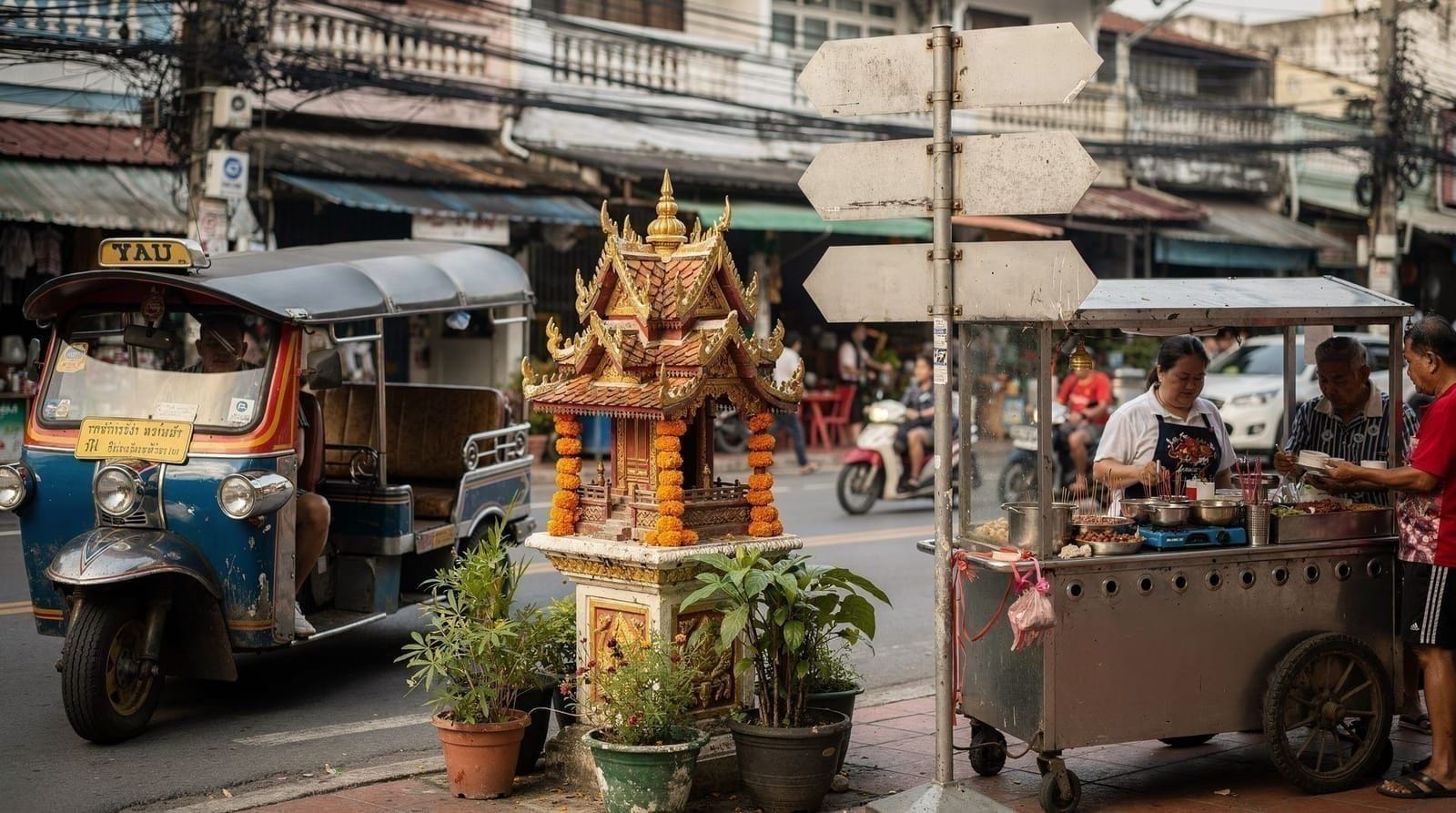
Phuket: Old town street food walking tour
Where should I stay in Phuket?
Kata Beach is the best all-rounder for first-timers — calm water, walkable village, mid-range hotels from 1,500 THB, and easy tour access. Choose Patong for nightlife, Bang Tao or Surin for upscale quiet, and Rawai or Nai Harn for a local feel on a tighter budget.
Phuket has 30+ named beaches along its 48 km of west coast, plus a small urban centre in the east. Choosing where to sleep determines everything from your daily commute to your noise levels at night. Here’s an honest guide to each main area.
| Best all-rounder | Kata Beach |
| Cost | Around 500–8,000+ THB/night depending on area and tier |
| Island length | 48km west coast, ~1hr north to south by car |
| Book ahead | 2–4 weeks in high season (Dec–Mar), 3–5 days low season |
| Getting around | Grab, songthaews, or scooter rental |
Patong — the tourist capital
Best for: Party travellers, solo travellers who want a social scene, backpackers with limited budget
Avoid if: You want to sleep before midnight, prefer clean water, or want to escape hawker pressure
Patong is Phuket’s largest and most touristic beach town. Bangla Road — the neon-lit entertainment strip — runs perpendicular to the beach and dominates the area’s identity. Clubs, bars, massage touts, and street food vendors operate until 2–4 am.
The beach itself is wide (3 km) with coarser sand than southern beaches, and the water is frequently murky from jetski traffic. In high season, sunbeds cover most of the sand by 10 am.
Accommodation range: Budget guesthouses from 400–700 THB/night (basic, noisy), mid-range hotels 1,200–2,500 THB, top-end options limited (Patong’s premium hotels are less prestigious than equivalents at Bang Tao). Best value time: monsoon season, when rates drop 40–60%.
Practical pros: Largest choice of restaurants (every cuisine), most ATMs, easiest tour pickups, cheapest transport options. Walking distance to Jungceylon shopping mall and multiple exchange booths (VASU for best rates).
Kata Beach — the first-timer’s choice
Best for: Couples, first-time visitors, families, mid-range budgets
Avoid if: You want pure luxury resort facilities or the nightlife of Patong
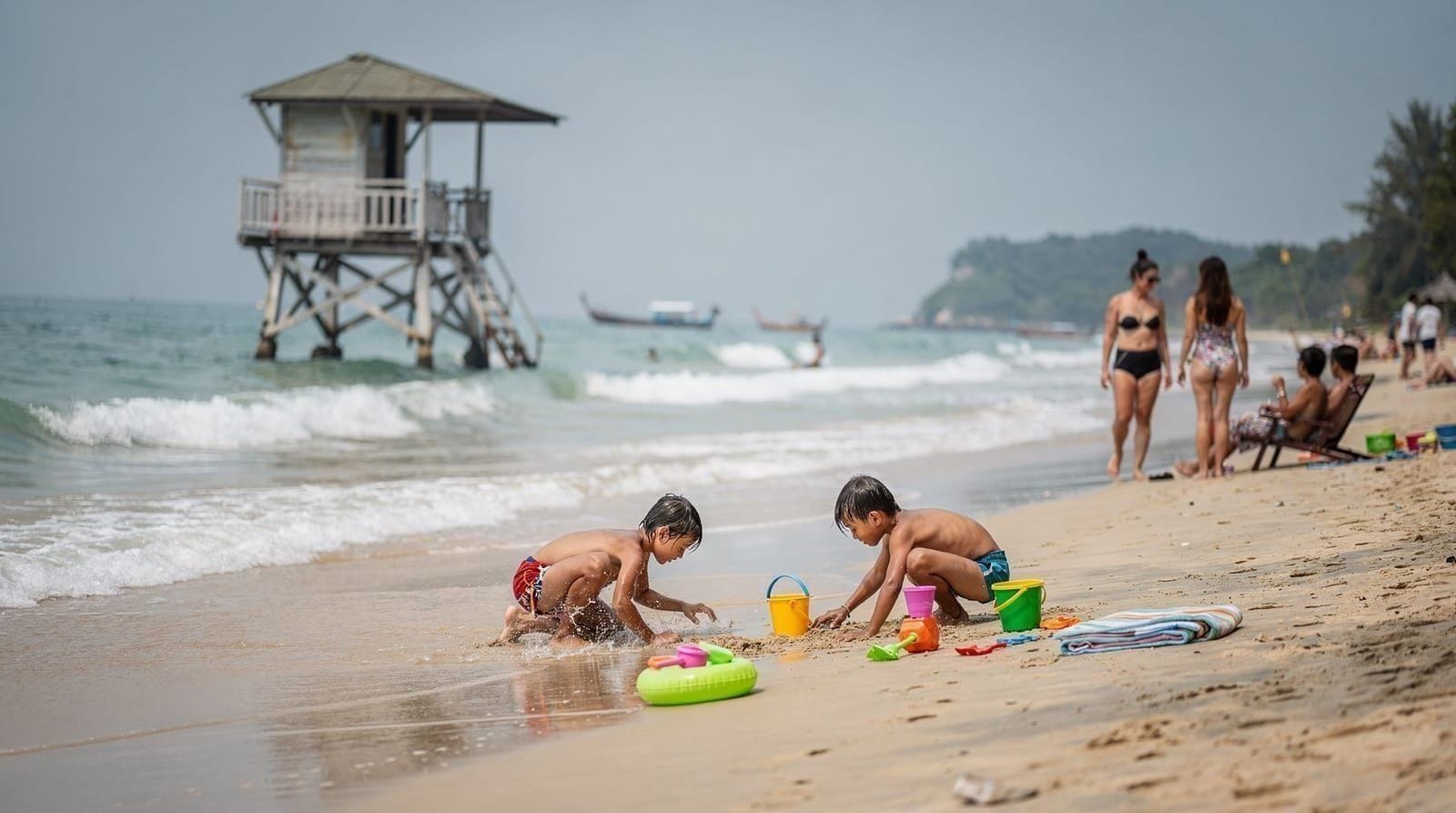
Kata Beach sits about 15 km south of Patong and is consistently the most balanced option for first-time visitors. The main beach faces west — excellent for sunsets — with calmer water than Patong. The village behind the beach has bakeries, good Thai restaurants at local prices, scuba dive shops, and a small walking street.
Kata Noi (Little Kata), a smaller cove immediately south, is quieter still and has direct beach access from several boutique hotels — worth paying slightly more for.
Accommodation range: Guesthouses from 600–1,000 THB, mid-range hotels 1,500–3,500 THB, boutique options 3,000–6,000 THB. Family-friendly resorts are plentiful in the 2,500–4,500 THB range.
Karon Beach — the quieter alternative
Best for: Couples, families, budget seekers who want space, first-timers who don’t want Patong
Avoid if: You want extensive restaurant options within walking distance
Karon Beach is Phuket’s longest beach — nearly 3 km of fine, squeaky white sand with notably fewer crowds than Kata or Patong. The trade-off is that the village behind the beach is less developed, with a limited restaurant strip.
Karon is roughly 10 minutes north of Kata by Grab (30–50 THB). Water quality is generally good. Karon Lake behind the beach provides a pleasant morning walk backdrop.
Accommodation range: Slightly cheaper than Kata for equivalent quality — mid-range hotels at 1,200–2,800 THB, family resorts 2,500–5,000 THB.
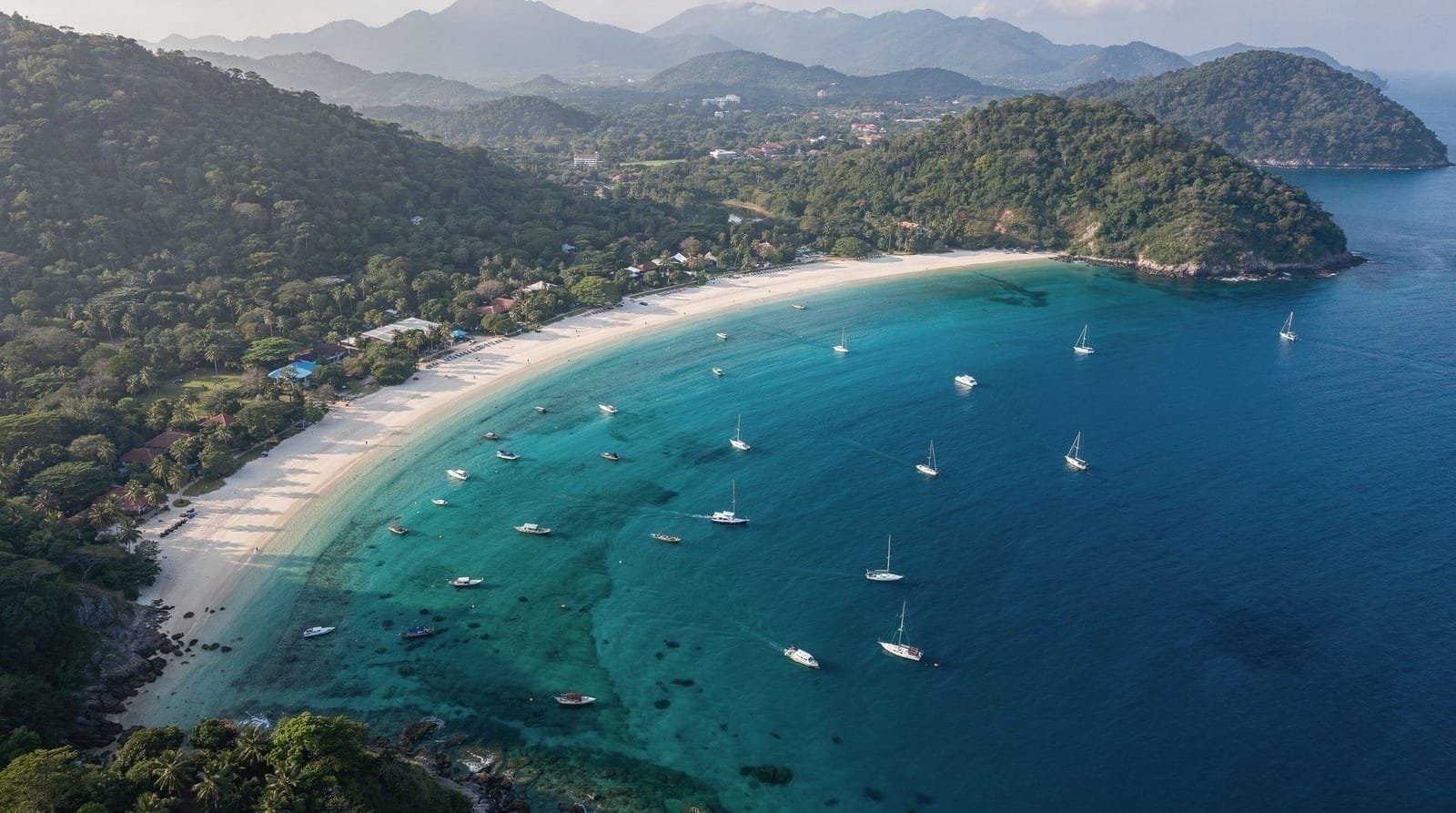
Sunset catamaran cruise from Karon BeachKamala Beach — the upscale middle ground
Best for: Couples wanting a stylish escape, families avoiding Patong noise, beach club enthusiasts
Avoid if: Budget is tight or you want a lively street food scene
Kamala sits between Patong (10 min north) and Surin (5 min north). It’s noticeably more upscale than Kata or Karon, with boutique restaurants, beach clubs (including Café Del Mar and Catch Beach Club), and a quieter village. The beach is a long straight bay with good swimming conditions.
Kamala is home to Phuket FantaSea entertainment park (large-scale Thai cultural show), which is popular with families.
Accommodation range: Mid to upper end — budget options are scarce. Expect 2,500–6,000 THB for quality options, with some boutique resorts reaching 8,000–15,000 THB.
Bang Tao Beach — the luxury resort strip
Best for: Honeymoon couples, families wanting resort-bubble convenience, luxury travellers
Avoid if: You want to explore independently, eat locally, or keep costs down
Bang Tao is anchored by the Laguna Phuket complex — a cluster of six 5-star hotels (Banyan Tree, Angsana, Cassia, Outrigger, Dusit, and others) sharing 4 km of beach. The setup is designed for guests who want everything on-site: multiple restaurants, watersports, a lagoon for kayaking, and a tram connecting properties.
Outside Laguna, Bang Tao has a growing strip of upscale villas and boutique hotels. The town area has some local restaurants and cafes, but it’s not a walkable food-and-culture hub in the way Old Town or Kata are.
Accommodation range: Laguna complex rates start around 5,000 THB/night and reach 25,000+ for suites. Independent villas and boutique hotels from 3,500–8,000 THB.
Surin Beach — boutique charm
Best for: Couples wanting calm and style, beach club day visitors, photography
Avoid if: Families with young children (steeper waves), budget travellers
Surin is a smaller beach (800 m) with a photogenic rocky headland framing the northern end. The water is clear, the sand is soft, and the beach club scene (Café del Mar was originally based here) is upscale without the industrial scale of Patong.
Swimming can be rough, particularly in monsoon when waves build. Not ideal for young children or nervous swimmers.
Accommodation range: Smaller selection — boutique hotels from 3,000–8,000 THB. Several excellent options within 500 m of the beach.
Rawai and Nai Harn — the local south
Best for: Couples, digital nomads, return visitors, divers
Avoid if: You want a beach to swim from Rawai itself (it’s a working fishing village, not a swimming beach)
The south coast around Rawai and Nai Harn has a genuinely local character that the west coast beaches lack. Rawai’s seafront is lined with local seafood restaurants where you point at fresh fish and get a price. The beach itself is shallow and tidal — not for swimming — but nearby Nai Harn is a beautiful sheltered bay 5 minutes away by scooter.
Nai Harn has good swimming when conditions are right, a large park and reservoir behind the beach, and a range of accommodation from guesthouses to the Rosewood Phuket (ultra-luxury, on a headland above the bay).
Accommodation range: Good value area — guesthouses from 500–900 THB, mid-range from 1,200–2,500 THB. Local restaurant prices are genuinely lower than tourist beaches.
Phuket Old Town — for the culturally minded
Best for: Culture enthusiasts, digital nomads, foodies, those who prefer urban base to beach
Avoid if: You want immediate beach access (20–30 min by Grab to nearest beach)
Phuket Old Town is the historic heart of the island — Sino-Portuguese shophouses, tiled facades, excellent street food, and a growing boutique hotel scene occupying heritage buildings. It’s genuinely one of the most atmospheric urban neighbourhoods in southern Thailand.
The trade-off is distance to the beach. Most visitors use Old Town as an evening destination rather than a base, but spending even 2–3 nights here gives a very different (and more authentic) Phuket experience.
Accommodation range: Growing boutique scene in converted shophouses from 1,500–4,000 THB. Good value mid-range guesthouses from 700–1,200 THB.
Phuket Old Town street food walking tourNorthern beaches (Nai Yang, Nai Thon, Mai Khao)
The north is the quietest part of the island and gets overlooked by most tourists. Mai Khao, near the airport, has Phuket’s longest beach (10 km, mostly empty), a JW Marriott and Renaissance hotel bookending the strip, and sea turtle nesting grounds. Nai Yang is a small beach with local restaurants and access to Sirinat National Park.
The advantage is near-total quiet. The disadvantage is that you’re a 45–75-minute drive from the island’s best attractions and tour piers.
Best for: Families who want the resort experience with no beach crowds, guests stopping near the airport.
What to know about transport between areas
Getting around within Phuket affects your experience as much as where you stay. Grab is the most practical option for point-to-point travel — fares for most intra-beach trips run 100–300 THB, and the app works reliably across the island. Rides from Phuket airport to the main beaches cost 400–700 THB depending on destination and traffic.
Shared songthaews (red vans with fixed routes) connect major beaches with Phuket Town for 30–60 THB per person — the cheapest option but not door-to-door and sometimes slow in peak traffic. They’re useful for the Patong–Kata–Karon corridor.
Tuk-tuks operate without meters. Always negotiate the price before getting in — typical short trips run 150–300 THB. Tuk-tuk drivers occasionally claim beaches or temples are “closed today” and offer to take you somewhere else — this is a known scam (see scams to avoid in Phuket). Verify directly with your hotel if in doubt.
Scooter rental (300–600 THB/day) gives complete flexibility and is how many repeat visitors explore the island. Photograph all pre-existing damage before riding and never hand over your passport as a deposit — this puts you in a weak position if damage is falsely claimed.
Seasonal considerations for accommodation
Where you stay and what you pay depends heavily on when you visit. High season runs November to March, with peak pricing in December and January. During this window, Kata and Patong fill early — booking 3–4 weeks ahead is wise for quality mid-range rooms.
April brings Songkran, the Thai New Year water festival, typically centred around the second week. Phuket’s Songkran celebrations are large — Old Town’s streets host major water fights, and accommodation in central areas books out. Prices spike for the holiday weekend.
During monsoon (June–October), rates drop 30–60% across most areas. The beaches are less reliable, but Phuket doesn’t shut down — rain often falls in intense short bursts rather than all-day drizzle, and the pools and indoor options remain fully operational. September is the wettest month and best avoided for a beach-focused trip; June and October are manageable.
Staying near the piers: a practical note for island-hopping trips
If your main goal is island day trips rather than beach relaxation, pier proximity matters. Rassada Pier on the east coast is the main departure point for Phi Phi Islands and Phang Nga Bay tours. Chalong Pier in the south serves Coral Island, Racha Island, and most diving operations.
Staying in Kata puts you 10–15 minutes from Chalong and about 20 minutes from Rassada. Staying in Patong adds 10–15 minutes to Rassada transfers. Rawai is closest to Chalong — useful if you’re diving most days.
Most tour operators include hotel pickup from Kata, Karon, Patong, and Kamala in their standard price. Bang Tao pickups sometimes carry a surcharge.
How to choose
| Priority | Recommended area |
|---|---|
| Best all-round first visit | Kata or Karon |
| Nightlife | Patong |
| Quiet luxury | Bang Tao, Surin, or Kamala |
| Families (calm water) | Kata or Kamala |
| Budget with character | Nai Harn or Rawai |
| Cultural experience | Phuket Old Town |
| Divers | Rawai (near Chalong Pier) or Kata |
| Near airport start/end | Nai Yang or Mai Khao |
Staying longer: digital nomads and extended stays
If you’re planning a stay of several weeks or more rather than a short holiday, the calculus shifts. Rawai, Nai Harn, and increasingly Kamala have the strongest infrastructure for longer stays — reliable co-working spaces, a steady expat community, and monthly accommodation rates that undercut nightly rates significantly. The Phuket digital nomad guide and best areas for remote work go into this in detail, covering internet reliability, co-working options, and visa considerations by area.
Monthly rates typically run 15,000–35,000 THB for a decent one-bedroom condo in the south, considerably less than the nightly-rate equivalent adds up to over 30 days. The cost of living in Phuket guide breaks down a realistic monthly budget beyond just accommodation. Whichever area you choose for a longer stay, getting around Phuket without daily Grab costs becomes a real consideration — most long-stayers rent a scooter monthly (3,500–5,000 THB) rather than paying per ride.
A final word on comparing quotes
Prices above are ranges, not guarantees — Phuket accommodation pricing shifts with season, day of week, and how far ahead you book. Always cross-check a quoted rate against the season table above before assuming you’re getting a fair deal, and see the Phuket money guide if you need a refresher on currency and payment norms before booking.
Frequently asked questions about Where to stay in Phuket — choosing the right beach for you
Is it better to stay in Patong or Kata?
What is the quietest beach in Phuket?
Which beach is best for families?
Where should couples stay in Phuket?
Is Phuket Town a good base for tourists?
Which beach has the best value for money?
Are all beaches accessible from any part of Phuket?
Should I book accommodation before arriving?
Top experiences
Bookable activities with verified prices and instant confirmation on GetYourGuide.