Best beaches in Phuket — ranked honestly for every travel style
Phuket: Coral Island snorkeling & water activities trip
What is the best beach in Phuket?
Kata Noi is the best overall beach — soft sand, clear water, and calm conditions. For families, Kata main beach or Kamala. For solitude, Nai Thon or Nai Harn. For sunset views with a beach bar scene, Surin. Patong is Phuket's most famous beach but not its best.
Phuket has over 30 named beaches along its west and south coastlines, ranging from the 3 km neon-backed stretch of Patong to tiny coves that hold fewer than 50 sunbeds. This guide ranks the best by category, not by marketing reputation.
| Best overall | Kata Noi |
| Best for families | Kata Beach or Kamala Beach |
| Best for quiet | Nai Thon or Nai Harn |
| Best sunsets | Surin Beach or Promthep Cape |
| Best season | November–April for calm, clear water |
The best beaches overall
1. Kata Noi (Kata Small)
Kata Noi is the island’s most complete beach: soft white sand, clear turquoise water, a rocky headland that shelters the cove from strong swell, and an intimate scale (about 400 m long) that keeps crowds manageable. A handful of hotels sit directly on the beach — pay the premium if you can. The main Kata Beach beach is 400 m north and shares the same quality, with a larger village and more accommodation.
Best for: Couples, photographers, anyone wanting the “postcard Phuket” beach experience
Practical notes: Beach chairs 100–150 THB/day. Minimal hawker pressure compared to Patong. Snorkelling possible at the rocky southern end.
2. Surin Beach
Surin is an 800 m crescent with soft sand framed by a rocky headland and casuarina trees. The water is typically clear, the beach club scene (Café Del Mar operates from here) is upscale without being trashy, and the overall vibe is markedly more sophisticated than the southern beaches.
Best for: Couples, beach club enthusiasts, day visitors from other areas
Practical notes: Stronger waves than Kata — not ideal for nervous swimmers or young children. Best in dry season (November–April). Sunset views are excellent.
3. Karon Beach
Karon is Phuket’s longest beach at 3 km, with fine white sand that makes a distinctive squeaking sound when you walk. Fewer beach hawkers than Patong, decent swimming conditions, and a quieter village behind the beach. The main downside is a limited walkable restaurant strip.
Best for: Families, couples seeking space, long beach walks
Practical notes: Water can have stronger currents than Kata at the northern end. Beach chairs 100 THB. Excellent sunset views from the northern rock shelf.
4. Nai Harn
Nai Harn is a sheltered bay in the far south with a large shallow lagoon behind the beach used by local kayakers. The beach itself has clear water and soft sand, the local restaurant strip on the access road has genuinely affordable food, and the Rosewood Phuket hotel on the cliff above is a useful benchmark for the area’s low-key upscale character.
Best for: Couples, budget travellers wanting quality, locals and return visitors
Practical notes: 5 minutes by scooter from Rawai. Promthep Cape viewpoint is 5 minutes further south — walk up at 5:30 pm for one of Phuket’s best sunsets.
Best beaches for families
Kamala Beach
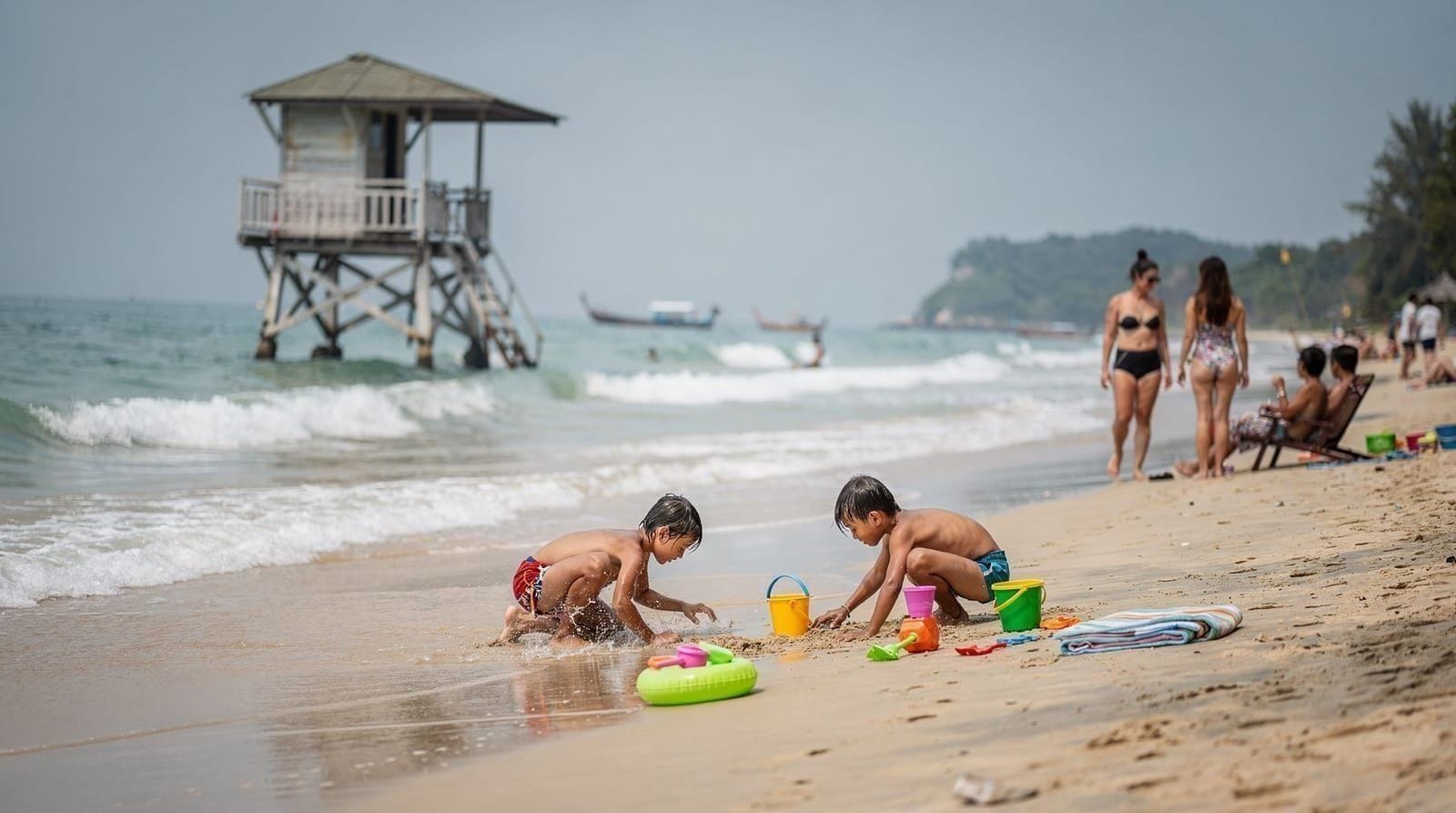
Kamala has calmer water than Patong (immediately north), a flat beach that’s easy for children, and direct access to beach clubs with changing facilities and food. The village behind has several family restaurants and supermarkets.
Best for: Families wanting calm water with some facility infrastructure
Practical notes: Phuket FantaSea (large cultural show and theme park) is 2 minutes from the beach — popular with families in the evenings.
Kata Beach (main)
Kata Beach’s main beach is slightly busier than Kata Noi but offers the same gentle waves, with the advantage of a more walkable village with pharmacies, restaurants, and tour operators.
Best for: Families with children under 10, first-time visitors
Practical notes: Has the most consistent surf school operations on the island (October–April for lessons). Reef snorkelling accessible from the southern end.
Best beaches for snorkelling
The reality: No Phuket beach rivals a good reef snorkelling trip. Even the “best” beach snorkelling on the island is mediocre compared to a half-day trip to Coral Island or Racha Island.
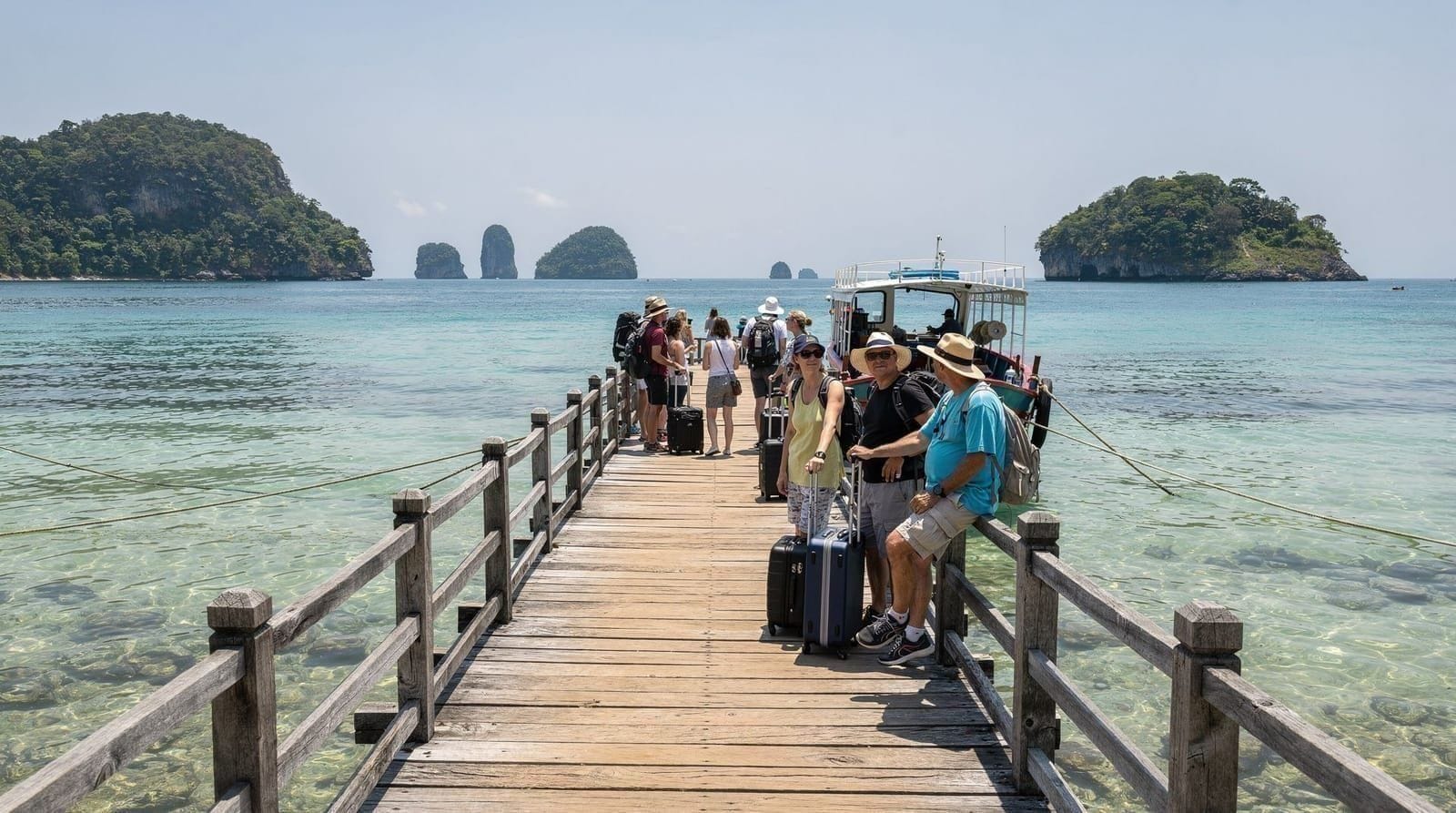
For the best snorkelling accessible by boat in under 30 minutes: Coral Island (Koh Hae) is a 20-minute speedboat from Chalong Pier. The reef at the island’s main beach has decent coral and fish life. A half-day trip including equipment runs 700–1,000 THB through local operators or 1,200–1,500 THB through tour companies.
Coral Island half-day speedboat trip from PhuketBest beaches for quiet and solitude
Nai Thon (Naithon)
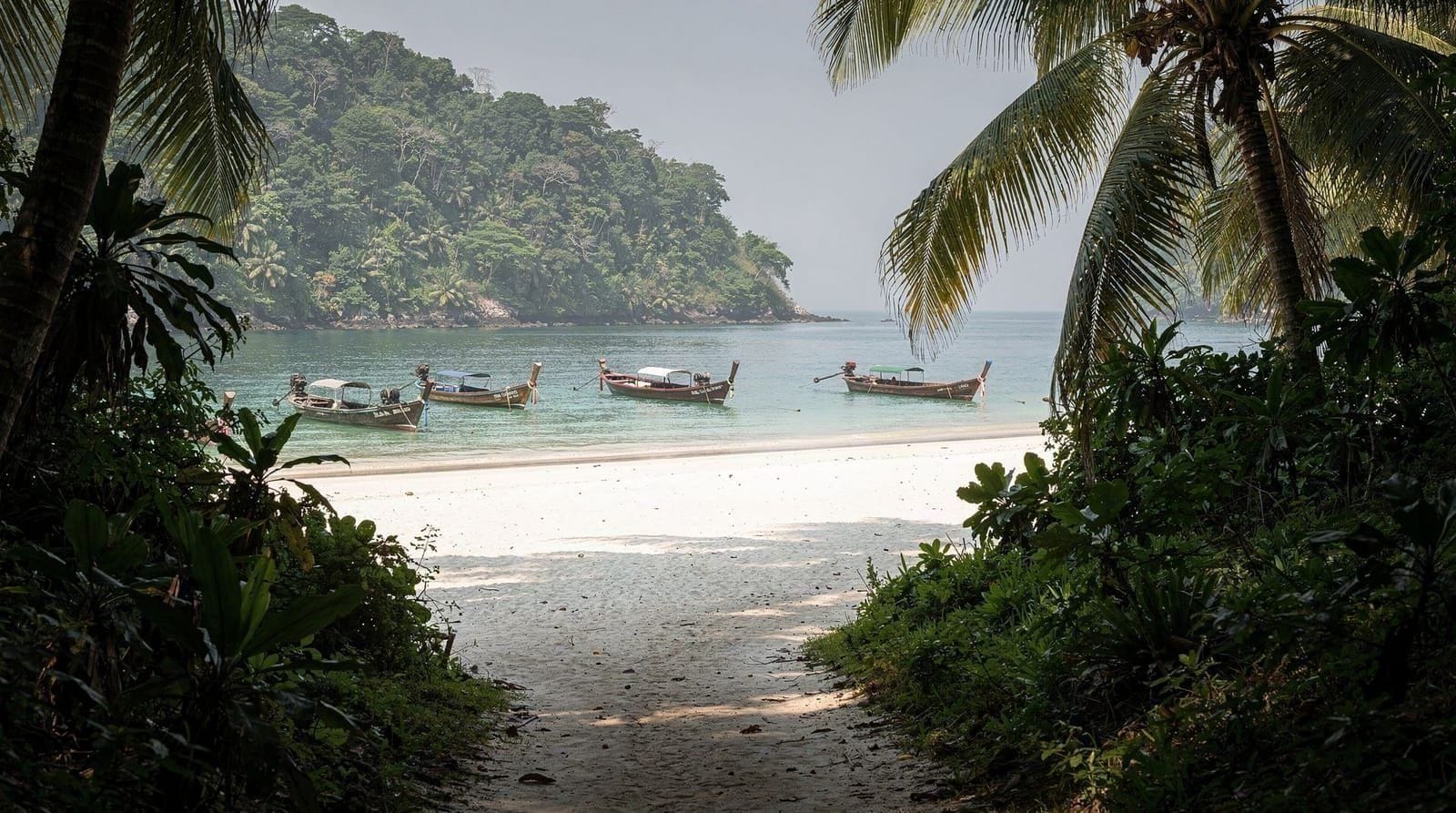
Nai Thon is a 700 m beach in the northwest with no beach clubs, minimal hawkers, and a single restaurant (Nai Thon Restaurant has been operating for decades). There are two luxury hotels (Trisara and The Shore at Katathani have properties nearby) but the beach itself is rarely crowded.
Best for: Travellers who want empty sand
How to get there: 20 minutes north of Bang Tao by Grab; 15 minutes south of Nai Yang. No songthaew service.
Laem Singh
A small cove between Kamala and Surin accessible by a path from the Kamala road. No vehicles, no beach chairs for hire (bring your own mat), and it’s only about 150 m of sand — but the water is crystal-clear and the setting is genuinely beautiful. Note: it can get crowded on weekends with day visitors.
How to reach: Park near the roadside, walk 5 minutes down a steep path.
Best beaches for sunsets
All of Phuket’s west-coast beaches face the Andaman Sea and get spectacular sunsets November through April (clear skies) and dramatic cloud-lit sunsets during monsoon. The best dedicated sunset viewing spots:
- Promthep Cape — southernmost point, elevated viewpoint, crowds gather 30 minutes before sunset. Go slightly early.
- Surin Beach — sunset from beach level with a beach club drink in hand.
- Freedom Beach — small cove near Patong, accessible by longtail boat, faces directly west. Almost empty at sunset.
Beaches to avoid (or approach with low expectations)
Patong — The beach quality doesn’t match the fame. Worth visiting for the nightlife and food scene, but don’t make it your primary swimming beach.
Rawai — A fishing village beach, not a swimming beach. The water is shallow and tidal, the beach is lined with fishing boats. The seafood market on the beachfront is excellent but you’re not here to swim.
Bang Tao (without a resort) — A beautiful wide beach, but accessing it without a resort involves walking across resort property or using unofficial access points. Better to stay at one of the Laguna hotels if Bang Tao is your target.
Sunset catamaran cruise via Coral IslandHow beaches compare by season
Phuket’s beaches behave very differently depending on when you visit, and choosing the right beach for the right month can make the difference between a relaxing swim and a red-flag warning.
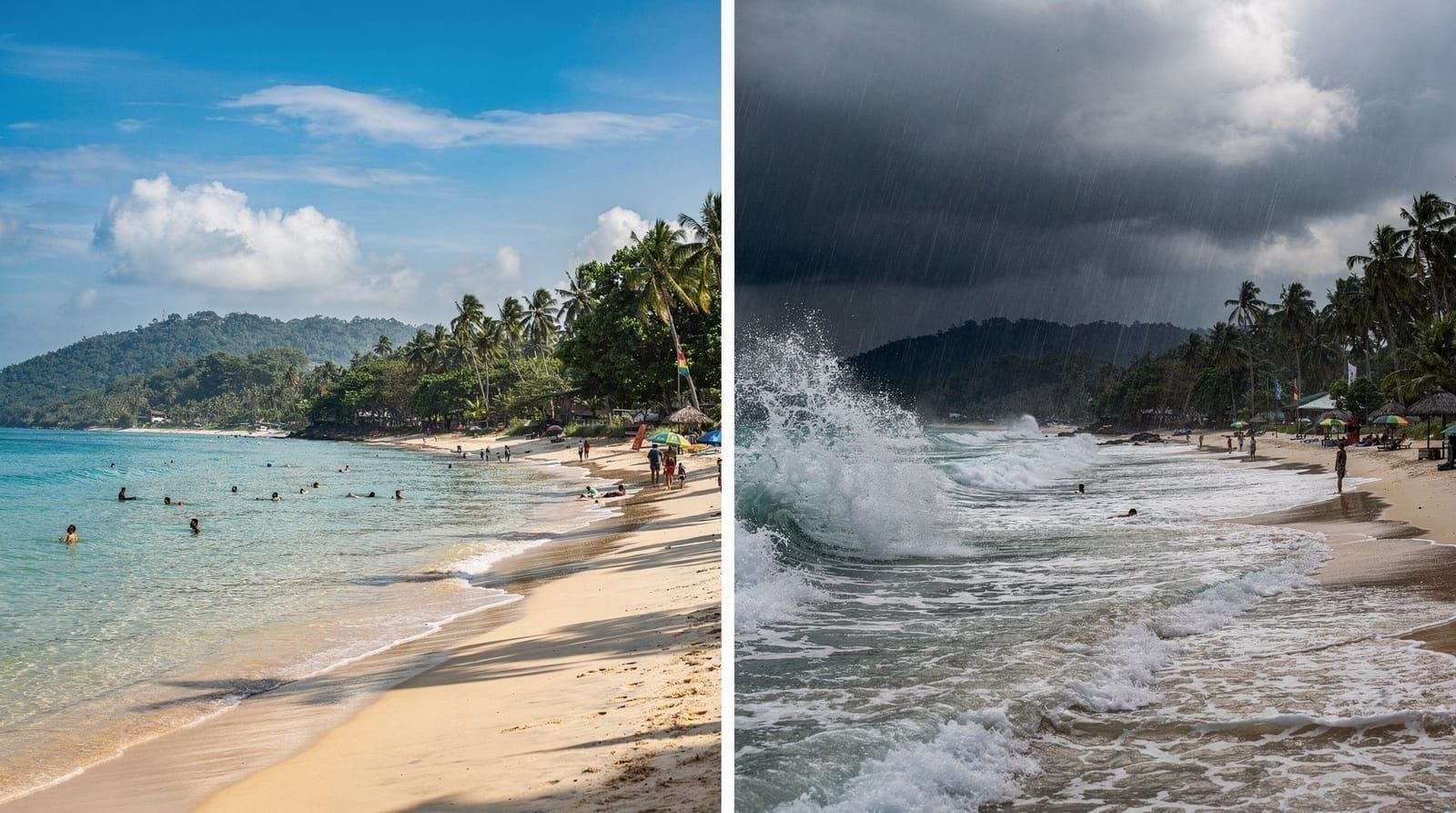
Dry season (November–April) is the sweet spot for all west-coast beaches. The southwest monsoon has cleared, skies are mostly blue, and the Andaman Sea settles into its calmest state of the year. Kata Noi, Surin, and Nai Harn are at their best — flat water, excellent visibility for snorkelling, and sunsets that justify the hype. Karon and Bang Tao also deliver: long stretches of sand that feel manageable even in high season because the sheer length absorbs the crowds.
Monsoon season (June–October) changes everything. The southwest monsoon pushes swell directly into Phuket’s west-facing coastline. September is the roughest month — sustained red flags on most main beaches, wave heights that can exceed 2 m on exposed stretches, and rip currents that run without warning. This is not the time to test your ocean swimming skills.
During monsoon, the flag system matters. The colour system used on Phuket beaches:
- Green flag — safe swimming conditions
- Yellow flag — swim with caution, conditions deteriorating
- Red flag — dangerous conditions, swimming not advised
- Red flag with skull — swimming banned, emergency conditions
Kata Beach has the most reliable lifeguard presence in high season and maintains flag enforcement throughout the year — it is the safest beach for families with children who might not heed verbal warnings. Karon and Kamala also have guards, but enforcement is less consistent off-season.
The relatively better monsoon options: Nai Yang (in the north, partially sheltered by the national park shoreline and orientation), Nai Harn (the southern headlands provide some protection), and the east-coast bay at Chalong (faces east, away from the dominant swell). None of these are flat-calm in peak monsoon, but they are meaningfully calmer than Patong or Karon when conditions are rough.
Shoulder months (May and October–November) are unpredictable. Early November can deliver some of the most dramatic skies on the island as the monsoon winds down — and flat water is possible several days in a row. May brings the first monsoon swells but patches of excellent weather. Check conditions daily rather than relying on generalisations.
For the full picture of how Phuket’s weather affects beach and island planning, see the best time to visit Phuket guide, which covers the transition months in detail.
Getting to the beaches: practical logistics
Phuket’s beaches are spread over 45 km of west and south coastline, so how you move between them matters as much as which ones you choose. Patong sits roughly in the middle of the west coast; everything radiates from there by distance.
Key distances and journey times:
- Patong to Kata: 8 km, approximately 20 minutes by Grab or scooter (the coastal road via Kata Noi adds 5 minutes but is more scenic)
- Kata to Karon: 2 km, 5–8 minutes — these two beaches are effectively next door and share the same neighbourhood
- Karon to Surin: approximately 15 km, 25–30 minutes (the road passes through Patong)
- Nai Harn to Rawai: 5 minutes, 3 km — these south-coast beaches are linked by a short flat road
- Patong to Nai Yang (airport area): 30 km, 45 minutes
Grab (Thailand’s dominant ride-hailing app) is the most practical way to move between beaches if you’re not renting a scooter. Intra-beach fares run 100–300 THB. A Grab from Patong to Kata typically costs 150–200 THB. From the airport to Kata or Karon, budget 400–700 THB depending on surge pricing.
Scooter rental is the most flexible option for beach-hopping and costs 300–600 THB per day depending on the bike and rental shop. The road connecting Karon and Kata Beach is flat and easy; the road from Kata south to Nai Harn climbs through hills but is straightforward. The route from the south coast to Patong via the hill road (Route 4029) is a steep climb but takes only 15 minutes and avoids the longer coastal route. An international driving licence is required to rent legally — check current enforcement levels with your accommodation.
Songthaews (shared pickup trucks) run fixed routes primarily along the main road (Route 4028) connecting Patong, Karon, and Kata — useful for single-beach stays but impractical for spontaneous beach-hopping. Fares are 30–50 THB per person.
If you’re planning to visit multiple beaches and possibly day-trip to the Phi Phi Islands or consider a multi-day itinerary, the phuket travel guide for first-timers covers transport logistics in detail including taxi versus scooter tradeoffs, and the how many days in Phuket guide helps allocate beach time within a broader trip structure.
What to bring to the beach
Phuket’s beaches are well-served commercially — you can buy almost anything at beach vendors or the 7-Eleven five minutes’ walk away — but packing right from your hotel saves money and reduces friction.
Sun protection: The tropical sun at this latitude is intense year-round, not just in summer. SPF 50 reef-safe sunscreen (required at national park snorkelling sites), a wide-brim hat, and a rash guard or UV shirt for extended water time are the essentials. Apply sunscreen 20 minutes before reaching the beach, not on arrival. Sunscreen from beach vendors runs 200–400 THB for a small bottle; buy at Tesco Lotus or Big C in town for 80–150 THB.
Water: Tap water is not safe to drink in Phuket. Bring a 1-litre bottle from your hotel and refill at the filtered water dispensers (1–2 THB/litre) found near most beach entrances and in town. Beach vendors sell 600 ml bottles for 30–60 THB — fine for convenience, but unnecessary if you plan ahead.
Cash: Beach chairs, cold drinks, snacks, and tip for boat rental all require cash. Bring small notes. The 7-Eleven near the beach is your emergency top-up point; the nearest ATM (220–250 THB withdrawal fee) is usually a 5-minute walk from any main beach.
A dry bag or waterproof case for your phone: Even if you’re not snorkelling, sudden rain, accidental wave splashes, and sandy wet hands can damage phones. A 150–250 THB waterproof sleeve from any dive shop is cheap insurance.
Sarong or beach towel: Hotels provide pool towels but often not beach towels (or limit them). A sarong doubles as a towel, beach mat, and cover-up for temples visited the same afternoon. Market stalls near any main beach sell them for 150–300 THB.
The beach vs island trade-off
One decision that often catches first-timers off-guard: the best water experiences near Phuket are not on the beaches themselves — they’re on the islands accessed by boat. This isn’t a reason to skip the beaches, but it’s worth understanding when planning your days.
Phuket’s west-coast beaches deliver excellent sunsets, comfortable swimming in dry season, long stretches of sand, and easy infrastructure. What they don’t deliver is the turquoise clarity and rich reef life you see in photographs of the Andaman. Those photographs are taken at Phi Phi Islands, at Racha Yai, at Coral Island, or at the Similan Islands — all accessible by speedboat from Phuket’s east-coast piers.
The practical implication: plan your island days as separate commitments from your beach days. An island day trip runs 7 am to 6 pm; it’s not something you tack onto a beach morning. For a 5-day trip, a reasonable allocation is 2 island days, 2 beach days, and 1 cultural day. That leaves you with two meaningful island experiences and two full days of beach relaxation rather than trying to compress everything into partial days.
The beaches that work best alongside island day trips logistically are Kata and Karon — they’re centrally located, close to Grab pickup points, and mid-island between Rassada Pier (Phi Phi tours, north Phuket) and Chalong Pier (Coral Island, Racha, dive trips, south Phuket). Staying at Kata means you can reach either pier in 25–30 minutes by Grab. For thinking through the full trip structure, the how many days in Phuket guide maps out the realistic allocation of days by trip length.
What “best” actually depends on in practice
Rankings like this one are useful as a starting point, but the honest caveat is that beach conditions shift day to day, not just season to season. Wind direction, tide timing and even the previous night’s rain can make a normally calm beach choppy for a morning, or turn a normally busy stretch into something quieter than expected. Hotel staff and beach vendors generally have a better read on that day’s actual conditions than any guide written in advance — it’s worth asking at breakfast rather than assuming yesterday’s flag colour still applies. This is especially true during the shoulder months (May and October–November), when conditions can swing meaningfully within the same week.
What changes between the north and south coasts
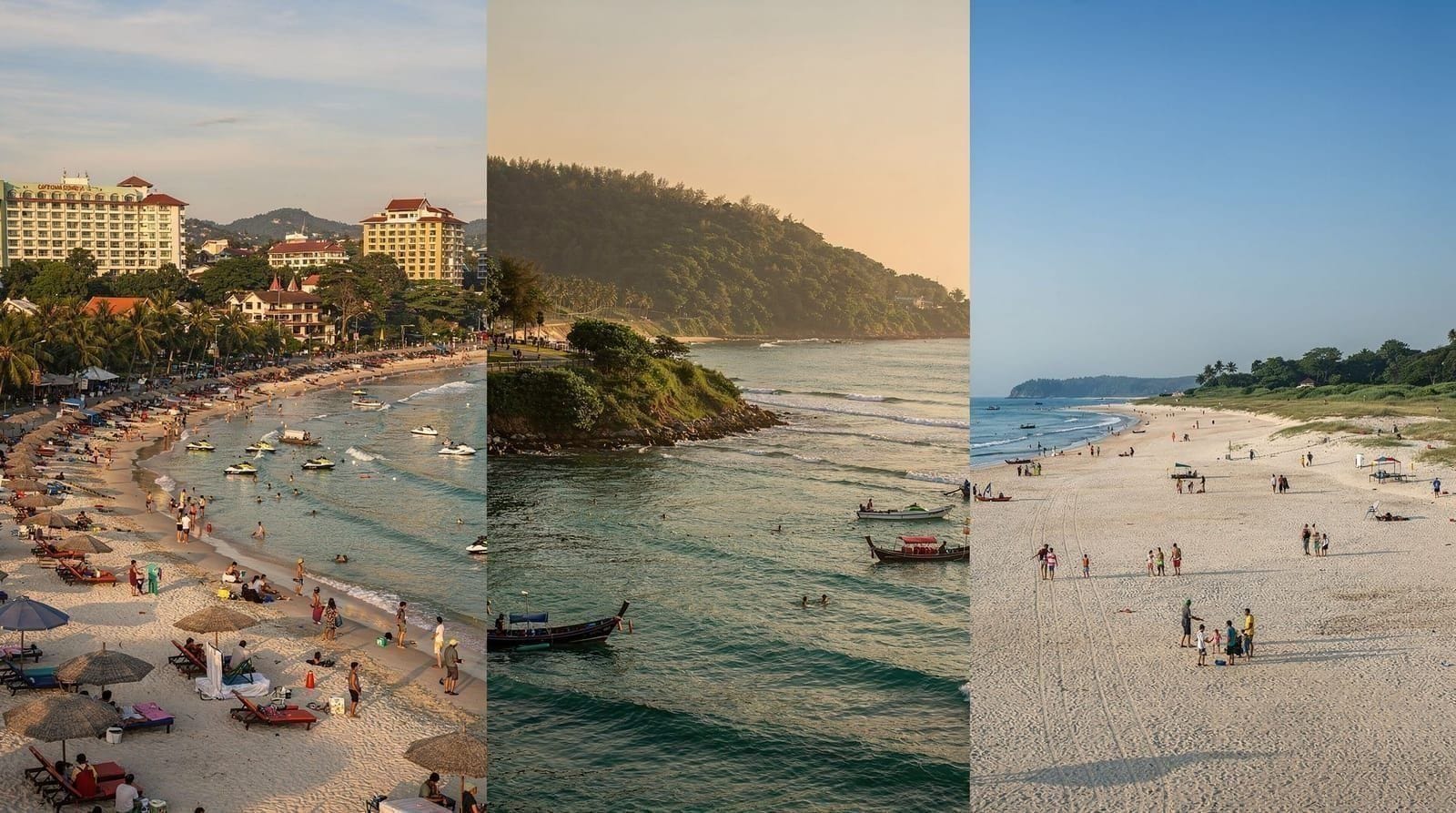
Phuket’s beaches aren’t uniform, and the geography explains a lot of the differences travellers notice. The southern beaches — Kata, Kata Noi, Karon, Nai Harn — sit closer to the sheltering headlands of the island’s southern tip, which tends to produce calmer, more consistent conditions even outside the driest months. The central-west beaches — Patong, Karon’s northern stretch — face more directly into the open Andaman and pick up more swell.
The northern beaches — Nai Yang, Nai Thon, Mai Khao — are flatter, quieter, and closer to the national park boundary, which keeps development lower and crowds thinner, but they’re also further from the island’s restaurant and nightlife density around Patong and Kata. If your priority is a quiet, undeveloped beach and you don’t mind a 30–45 minute drive to dinner options, the north rewards the trip. If you want beach, food and evening activity within a short walk of each other, the Kata-Karon corridor remains the more practical base.
Choosing a beach by what you actually want from it
Rather than a single “best beach,” it helps to match the choice to your priority. If swimming quality is what matters most, Kata Noi and Nai Harn consistently deliver the clearest, calmest water. If you want beach infrastructure — sunbeds, restaurants, watersports — within walking distance, Karon and Kata’s main beach handle that better than the quieter coves. If people-watching and nightlife proximity matter more than the sand itself, Patong still earns a visit for an evening even if it’s not the swimming beach on this list. And if you’re weighing a beach day against a boat day, remember the honest trade-off above: the best water clarity near Phuket is on the islands, not the mainland beaches.
Frequently asked questions about Best beaches in Phuket — ranked honestly for every travel style
Which beach in Phuket has the clearest water?
Are any Phuket beaches good for snorkelling?
Which beaches are calm and safe for swimming?
Which Phuket beach is best for sunrise?
Are there any uncrowded beaches in Phuket?
What is the best beach for a beach club experience?
Which beach is best for surfing?
Is Patong Beach worth visiting?
Top experiences
Bookable activities with verified prices and instant confirmation on GetYourGuide.