Phuket–Krabi combo itinerary — 7 days on both coasts
Phuket: Phi Phi, Maya Bay & Khai Island day tour by speedboat
How do you combine Phuket and Krabi in 7 days? Split 4 nights in Phuket (Phi Phi, Phang Nga Bay, Old Town) and 3 nights in Krabi (Railay Beach, Tiger Cave, 4 Islands tour). The Phuket–Krabi transfer takes 1.5–4 hours depending on method. Budget 5,000–9,000 THB per person per day ($153–$276 USD) mid-range.
| Best for | Couples, adventure seekers, first-timers wanting variety |
| Split | 4 nights Phuket, 3 nights Krabi/Ao Nang |
| Cost | Around 24,250–43,400 THB/person total, 7 nights |
| Getting around | Minivan or speedboat transfer, Grab/longtails locally |
| Book ahead | Phi Phi and Phang Nga Bay, 2–3 days minimum |
Why Phuket and Krabi work together
Phuket and Krabi are 50 km apart by water (1.5 hours by speedboat, seasonal) or 2.5–3 hours by road. They share the Andaman coast but feel completely different: Phuket is larger, more developed, with better infrastructure; Krabi is rawer, more dramatic, with the iconic Railay limestone peninsula and a more backpacker-friendly feel.
Done right, this combo lets you experience the full range of the Andaman coast without backtracking. The key is committing to 4 nights in Phuket and 3 in Krabi — not trying to day-trip between them, which wastes 4–5 hours of travel time per trip.
Seasonal note: The Phuket–Krabi express speedboat (Tigerline/Koh Phi Phi) runs November–April only. In May–October, travel via the ferry via Phi Phi or by road (minivan/taxi: 2.5–3 hours, 500–900 THB/$15–$28 per person). Plan accordingly.
Comparing the two destinations side by side: Phuket has the edge on organised tours, quality dive operators, and sheer density of restaurants. Krabi wins on dramatic scenery — the limestone karsts here are taller, closer to the sea, and more immediately striking than anything on the main island. For first-timers who have 7 full days and want to feel like they’ve genuinely explored the region, doing both is the right call. For anyone with 5 days or fewer, pick one and go deep rather than rushing both.
The best time to visit Phuket is November through March when both coasts are at their finest. However, the May–October monsoon doesn’t make this combo impossible — just different. Phi Phi tours continue year-round though seas may be rougher; Phang Nga Bay stays sheltered and excellent; Railay and Tiger Cave are fine throughout the year. Budget travelers sometimes prefer shoulder season (April, October) for lower accommodation prices and thinner crowds.
Days 1–4 in Phuket
Day 1 — Arrival and Phuket Town
Land at HKT, Grab to hotel (~400–700 THB/$12–$21 depending on base). For this combo itinerary, staying in central Phuket or Patong makes most sense — proximity to Rassada Pier for Day 2 is the priority.
If you land by noon, use the afternoon productively: head to Phuket Old Town for a soft landing. The Sino-Portuguese shophouse streets around Thalang Road and Dibuk Road require no booking and take 2–3 hours at a relaxed pace. The old town has a distinct, unhurried quality that sets the right tone before the busier tour days ahead.
Evening in Phuket Old Town: dinner on Dibuk Road is the local-approved choice. Raya Restaurant at the corner of Dibuk and Atsadang serves classic Phuket dishes — Mee Hoon Phuket (local noodles with crab, 200–280 THB/$6.15–$8.60) and the surprisingly good gaeng phed moo (pork red curry, 180 THB/$5.52). A short walk away, Natural Restaurant on Soi Romanee is slightly more touristy but has a good selection of Southern Thai seafood at honest prices (250–400 THB/$7.67–$12.27 per dish). You’ll have more time in Old Town on Day 3 if you want to go deeper.
First-night practical tip: Exchange currency before leaving the airport — the airport’s SuperRich counter offers rates close to the bank rate. ATMs in Old Town charge 220 THB ($6.75) foreign transaction fees; the airport counter is worth the 3-minute queue. See our Phuket money guide for the full breakdown.
Day 2 — Phi Phi Islands
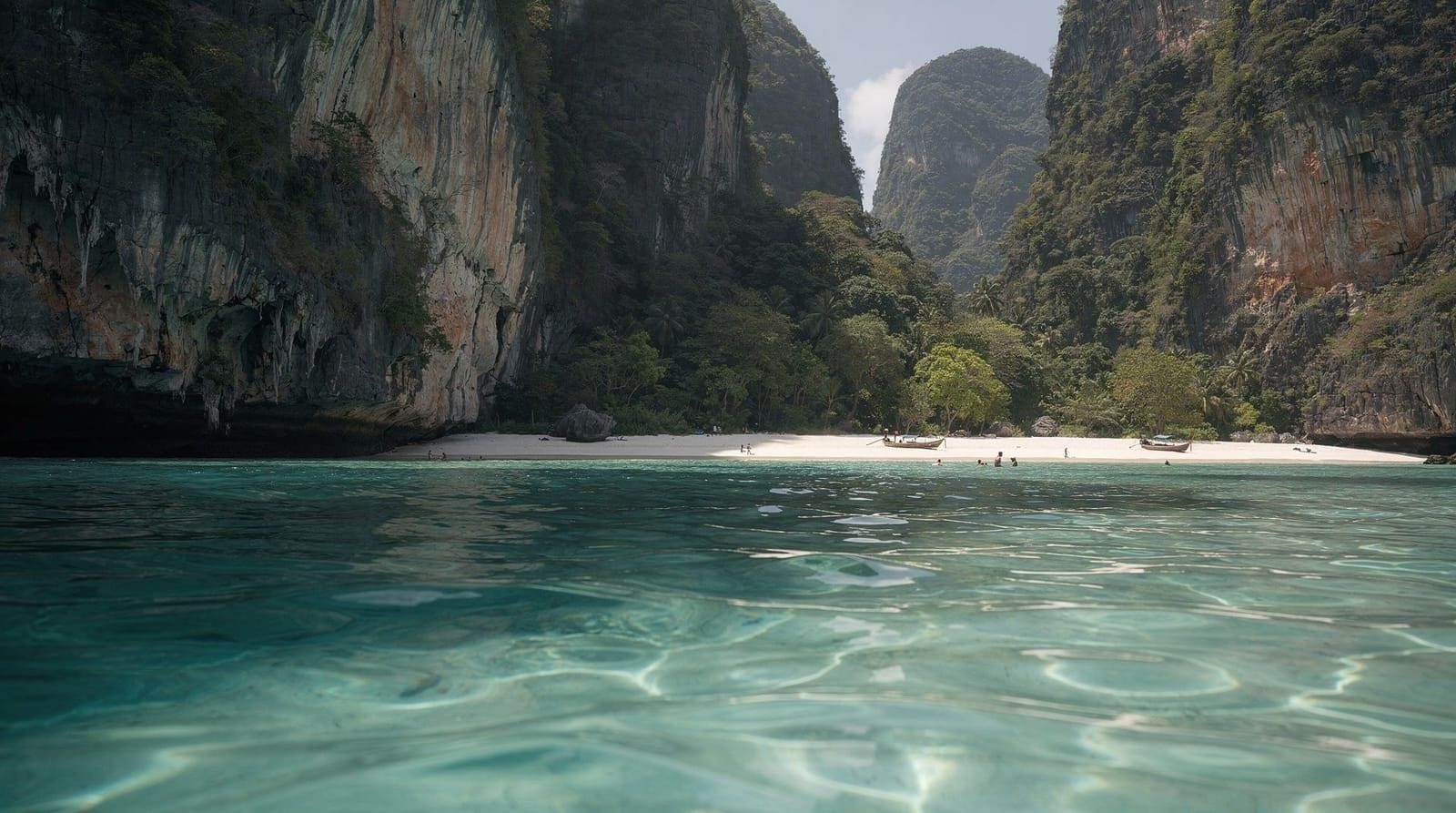
The Phi Phi speedboat day trip is the headline Phuket activity and sets the scene for the whole coast. It covers Phi Phi Don (village, viewpoint), Maya Bay (restricted access post-2022 reef restoration — swimming inside the bay prohibited), Monkey Beach, and Bamboo Island snorkeling. Lunch included on most tours. Back to Phuket by 5:30–6pm.

Importantly: Phi Phi sits between Phuket and Krabi. When you transfer to Krabi on Day 5, you’ll actually pass through the same waters. You won’t need to return specifically for Phi Phi from the Krabi side.
What to know about the day: the 90-minute speedboat crossing is the part that catches people off-guard. Open Andaman Sea in November–February is usually fine; May–October can be genuinely rough. Take anti-nausea tablets an hour before departure (available at 7-Eleven for 35 THB/$1.07) and sit toward the centre-back of the speedboat rather than the bow. Bring a rash guard — you’ll be in and out of the water multiple times and the reflected sun is intense.
Maya Bay: the no-swimming rule is properly enforced. Rangers in boats redirect anyone who enters the protected zone. The bay is still spectacular from the boat and from the viewpoint trail on the western cliff. The reef restoration work since 2022 is visible — coral coverage has improved noticeably compared to pre-closure conditions.
Back to Phuket by 5:30–6pm. The Phi Phi Islands guide has the full tour operator comparison.
Day 3 — Phuket Old Town, Big Buddha, Chalong
Dedicated culture day. Morning in Phuket Old Town: Thalang Road shophouses, Jui Tui Shrine, the food market around Ranong Road. The Phuket Thai Hua Museum on Krabi Road (entry 200 THB/$6.13) gives excellent context on the Hokkien Chinese community that shaped Old Town’s architecture and culture — worth an hour before the street walk.
For breakfast in Old Town: Kopitiam by Wilai on Thalang Road is the local institution — kaya toast, soft-boiled eggs, and local coffee for 80–120 THB ($2.45–$3.68) total. Opens at 8am. Arrive by 8:30 to beat the queue.
Afternoon: Grab south to Wat Chalong (free entry, cover shoulders and knees) — Phuket’s most revered Buddhist temple and largest, with a reliquary said to contain fragments of the Buddha’s bone. Respectful, unhurried visit takes 45 minutes. From there, up to Big Buddha on Nakkerd Hill (30 minutes by Grab, ~150 THB/$4.60). The 45-metre marble statue is most impressive from a distance; up close the surrounding souvenir stalls are distracting. The views from the hill over southern Phuket are the real reward — on clear days you can see all the way to Racha Island.
Wat Chalong and Big Buddha are both free to enter. Budget the afternoon for both; Grab between them costs ~100 THB ($3.07).
Optional evening: the Simon Cabaret in Patong is Phuket’s best-known evening entertainment — three shows nightly (800–1,200 THB/$24.50–$36.80, book ahead). It’s a professional production with genuinely impressive costume and choreography, not the low-rent ladyboy show the reputation might suggest.
Day 4 — Phang Nga Bay
Before leaving Phuket, do the Phang Nga Bay tour. It’s one of the coast’s signature experiences and much harder to access from Krabi (the bay is between the two destinations, closer to Phuket).

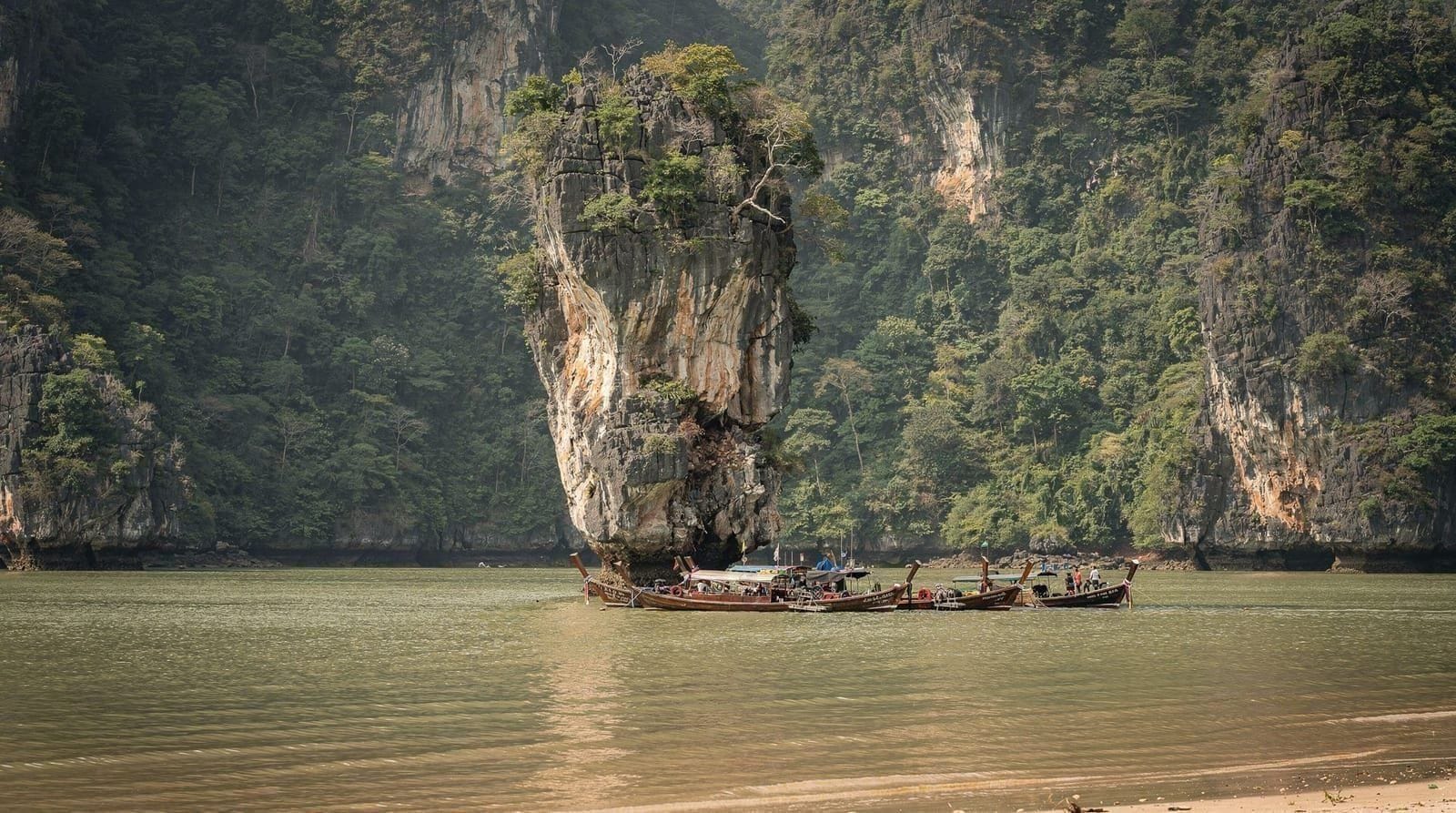
The small-group longtail tour covers James Bond Island (Khao Phing Kan), Koh Panyi floating village, and sea cave canoeing. Full day: 8am–5pm. See our James Bond Island guide for operator comparison.
What distinguishes the small-group longtail from the big-boat tours: longtail boats can navigate into sea caves (hongs) that large vessels can’t enter. Inside a hong — a collapsed cave system open to the sky, surrounded by vertical jungle-covered limestone — the sound of the water and the light through the canopy opening above is memorable in a way the big-boat version simply isn’t. The longtail is also slower, which sounds like a drawback but actually means you spend more time in the places worth lingering.
Koh Panyi: the floating village is on most tour routes but the quality of the visit varies enormously. The small-group tour gives you 40–50 minutes to walk the boardwalks independently rather than 15 minutes in a queue of 50 tourists. The village’s mosque (the white-and-gold minaret visible from the water) was built in 1878 and is still in active use. Respectful visits allowed during non-prayer times.
The Phang Nga Bay sea canoe guide covers what to expect in each season and which operators manage the sea caves responsibly.
Pack bags in the evening — you move to Krabi the next morning. Book your Phuket–Krabi transport now if you haven’t (minivan from Phuket Town or hotel pick-up, 350–500 THB/$10.75–$15.35 per person).
Day 5 — Transfer to Krabi and arrival
Phuket to Krabi options
Speedboat (November–April only): ~1.5 hours, 600–900 THB ($18–$28) per person, departs Rassada Pier. Some routes stop at Phi Phi en route. Easiest if it’s running.
Minivan: 2.5–3 hours, 350–500 THB ($10.75–$15.35) per person. Departs from several Phuket points (book via guesthouse). Comfortable, air-conditioned, door-to-door. This is the practical default for most travelers May–October.
Private taxi: 2.5 hours, 2,500–4,000 THB ($76–$123) per car. Most convenient with luggage or a group. A group of 4 sharing a private taxi to Ao Nang costs less per person than the minivan, with added luggage comfort.
Ferry via Phi Phi: Slow (4+ hours, stops at Phi Phi Don). Only useful if you want to stop for a night on Phi Phi — see the Phi Phi Islands guide for accommodation options there.
For most travelers, the minivan from Phuket to Krabi Town (or Ao Nang) is the practical choice. Read more in our Phuket to Krabi transport guide.
Tourist trap warning: At Phuket bus stations and piers, “travel agents” approach solo travelers offering a bundled minivan + accommodation deal. These almost always route you to commission-paying guesthouses of variable quality. Book the minivan through your hotel or a reputable online service and book accommodation separately.
Ao Nang base
Krabi/Ao Nang is your base for the next three nights. Ao Nang Beach is fine (better than Patong, worse than Railay) with a walkable restaurant strip. Most accommodation options are 800–3,000 THB ($24.50–$92) per night.
For mid-range: Ao Nang Cliff Beach Resort has good pool and sea views (1,800–2,800 THB/$55–$86 per night). For budget: The Leaf on the Rock and Ao Nang Budget Inn both sit 5–10 minutes walk from the beach (600–900 THB/$18.40–$27.60). For something quieter, the guesthouses on the inland side of the main road are consistently 20–30% cheaper than beachfront equivalents.
Evening: walk Ao Nang’s beach promenade, eat at one of the seafood grills on the main beach road. Ay’s restaurant (reliable, local, 200–400 THB/$6.15–$12.25) near the beach is a good intro. For something more substantial, Wanna’s Place on Ao Nang 3 Road has an honest Thai menu without the beach-view markup — massaman curry, 180 THB ($5.52); whole grilled sea bass, 350 THB ($10.74).
Day 6 — Tiger Cave Temple, Emerald Pool and hot springs
Krabi’s inland highlight is a half-day that most visitors skip in favour of yet another beach tour. Tiger Cave Temple (Wat Tham Sua) is 8 km from Ao Nang — a 1,237-step staircase to a summit shrine with 360° views over Krabi’s limestone landscape. Start early (7am); the climb takes 45 minutes and it’s steep. Wear shoes, not sandals. Bring 1.5L of water per person — the climb is exposed and there’s no shade on the upper section.
The view from the summit rewards every step: you’re looking out over a carpet of palm trees broken by vertical limestone towers, with the Andaman coast glinting at the horizon. The summit chedi (golden stupa) is an active place of worship — remove shoes, behave respectfully. Entry to the temple grounds is free; the staircase climb is also free.
Emerald Pool (Sra Morakot) is 45 km inland — a series of mineral-rich freshwater pools in Khao Phanom Bencha National Park. The colour is genuinely turquoise, not a photo filter. The mineral content (sulfur, calcium carbonate) gives the water its characteristic teal tone. Cool water (25°C) after the Tiger Cave climb is exactly what’s needed. Entry fee: 200 THB ($6.13) adults, 100 THB ($3.07) children under 14. Open 8am–6pm; arrive by 9am to beat coach tour groups.
The Blue Pool, 800m further along the trail from Emerald Pool, is smaller, more vivid in colour, and prohibits swimming (the water is too hot near the source). It’s a 5-minute walk and worth doing.
The combined tour with hot springs is the most efficient structure:

Back to Ao Nang by 4–5pm. The Krabi Hot Springs (Ban Khlong Thom Nuea) are part of the same national park area — small natural pools fed by mineral springs at 35–40°C. Entry 90 THB ($2.76). Less dramatic than dedicated hot spring parks but genuinely relaxing after the Tiger Cave climb. Rest, then dinner on the beach.
Day 7 — Railay Beach and 4 Islands, departure
Morning: Railay Beach
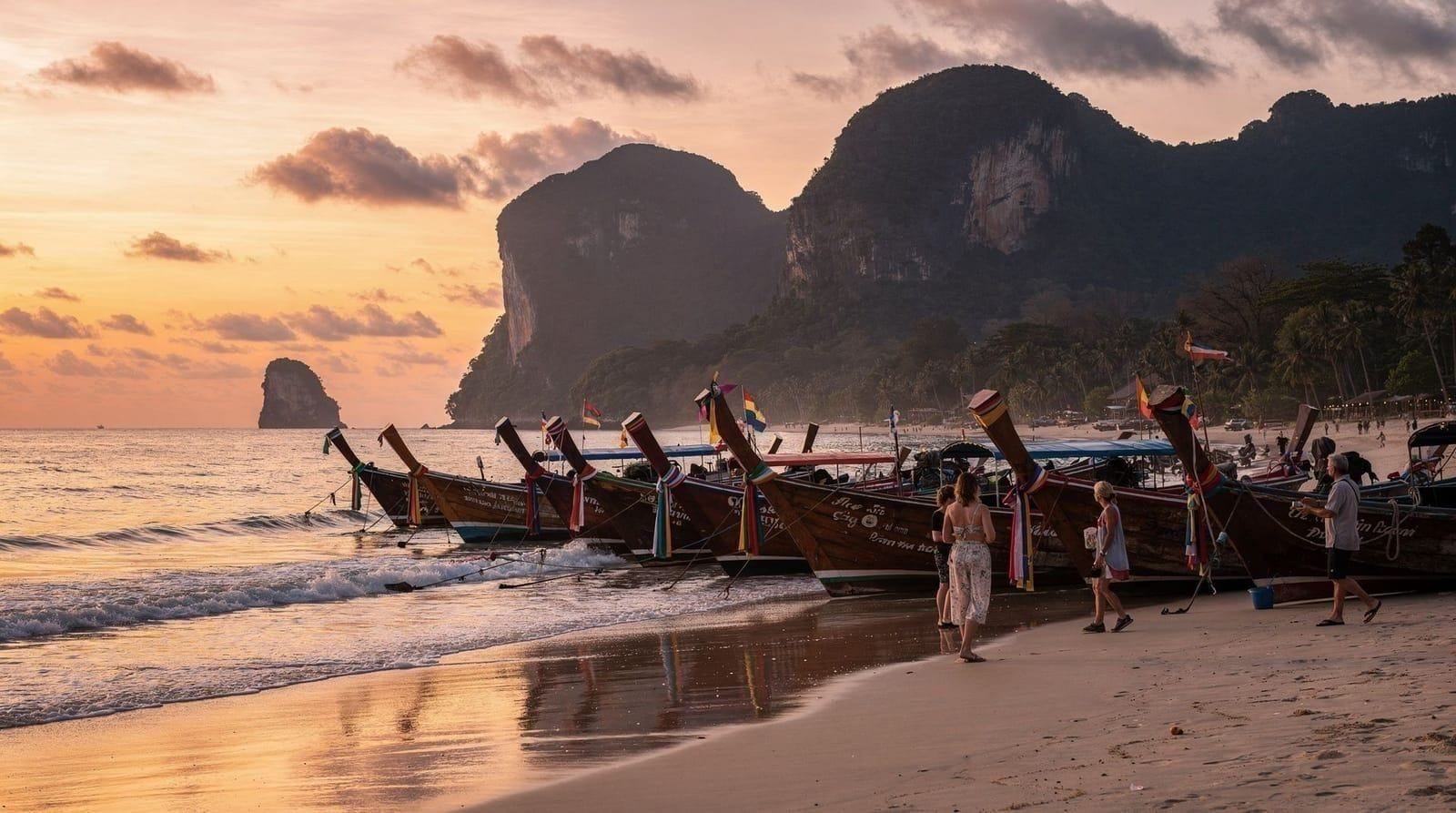
Railay Beach is 15 minutes by longtail from Ao Nang (~150 THB/$4.60 each way, boats depart when full from Ao Nang Beach). It’s technically a peninsula but only reachable by water — the dramatic limestone cliffs cut it off from the mainland road network.
Longtail boats from Ao Nang run all day but the first departures are 7–7:30am. Going early means 90 minutes at Railay before the day-trip crowds arrive from Ao Nang. The morning light on the western cliff faces is spectacular. Arrive at Railay West and walk south across the narrow land strip to Phra Nang Cave Beach immediately — this 15-minute walk is the best thing you’ll do in Krabi.
The west beach (Railay West) has calm water and the tourist infrastructure — restaurants, bars, accommodation. The east beach is muddy and tidal — interesting but not for swimming. Phra Nang Cave Beach, at the tip of the peninsula, is the most striking — a royal shrine in a cave at the base of a massive limestone wall. The shrine is an active place of Hindu worship (carved phalluses left as offerings are part of the genuine ceremony; it’s not a tourist gimmick). The beach itself is consistently voted one of Thailand’s most beautiful.
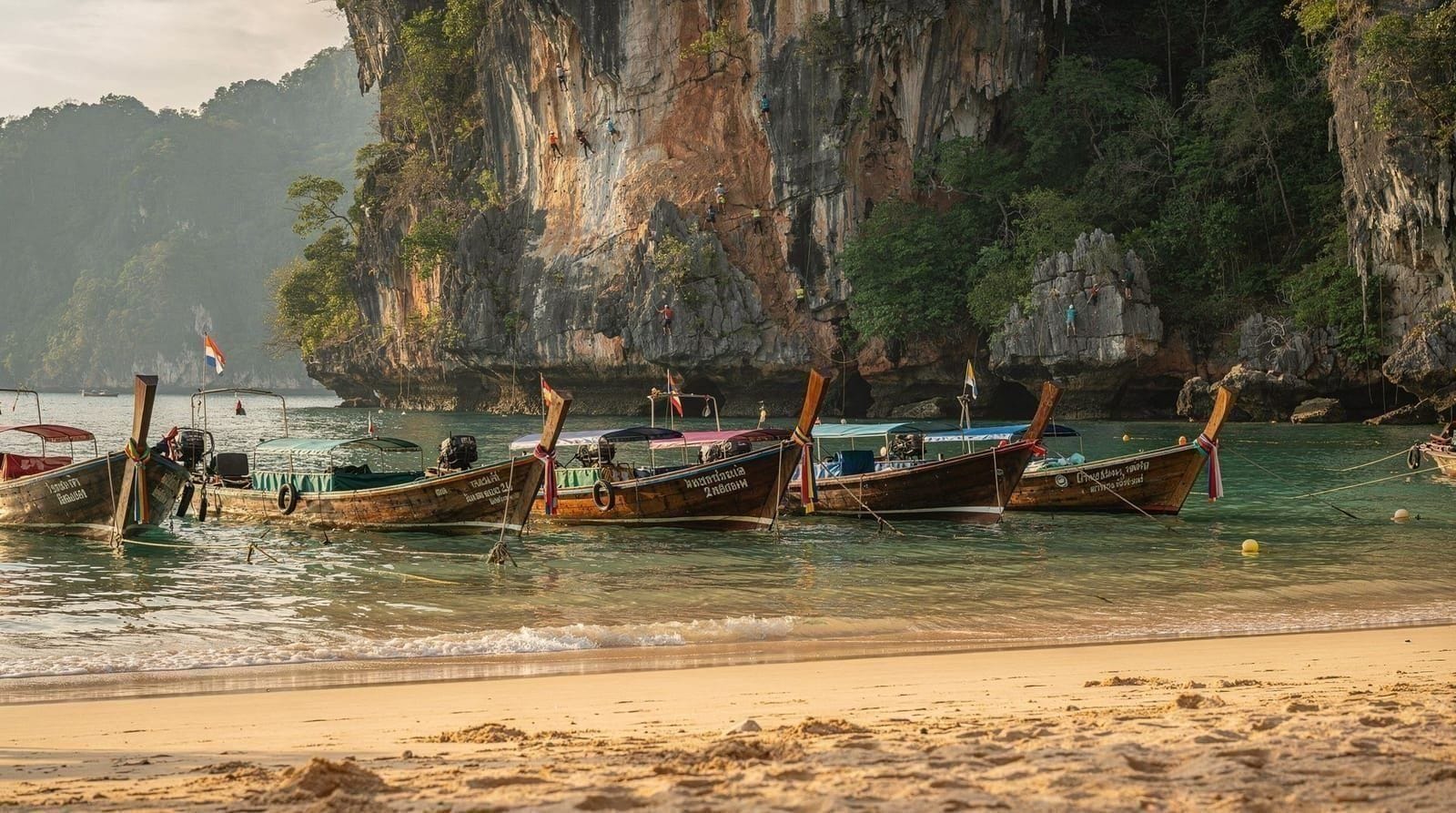
If rock climbing is on your list, Railay is Thailand’s best sport climbing destination with 750+ bolted routes from beginner to expert:

Half-day sessions run 8am–noon or 1pm–5pm. Instructors from Base Camp Tonsai (on the beach) are well-regarded; cost for a half-day with instruction and gear is typically 1,200–1,800 THB ($36.80–$55.21) per person. Back at Ao Nang by lunchtime or early afternoon.
Afternoon: 4 Islands tour (or departure prep)
If your flight is from Krabi Airport (KBV) in the evening, the Krabi 4 Islands speedboat tour fits between Railay and your flight. The 4 Islands covers Koh Poda, Koh Gai (Chicken Island), Tub Island (walkable sandbar at low tide), and Phra Nang Cave Beach — a different circuit from Railay proper.

Half-day tours run morning and afternoon (3–4 hours). Choose the morning option and leave afternoon free for departure. Koh Poda is the standout: a 15-minute walk around the island (the whole thing) reveals three different beach faces, a low rocky promontory for seabird watching, and genuinely clear water for snorkeling off the western tip.
Krabi Airport (KBV) from Ao Nang: 30–45 minutes by Grab (~300–500 THB/$9.20–$15.35). International connections are usually via Bangkok (BKK or DMK). Domestic flights to Bangkok: 1 hour, 1,500–3,000 THB ($46–$92) budget carrier. If you’re flying internationally from Phuket instead, factor in the 2.5-hour road transfer back — doable with an evening flight.
Final warning on scams: Ao Nang’s longtail beach is full of unofficial boat “agents” who approach tourists offering “special price” tours. Always book through your hotel or a reputable desk, not beach touts. Prices should be fixed and the operator named. See our Phuket scams to avoid guide — the same tactics operate in Krabi.
Budget breakdown (per person, mid-range, 7 nights)
| Item | THB | USD |
|---|---|---|
| Accommodation Phuket (4 nights) | 7,200–12,000 | $221–$368 |
| Accommodation Krabi (3 nights) | 4,500–9,000 | $138–$276 |
| Phi Phi day trip | 1,800–2,500 | $55–$77 |
| Phang Nga Bay tour | 1,200–1,600 | $37–$49 |
| Phuket–Krabi transfer | 350–4,000 | $10–$123 |
| Krabi Tiger Cave/Emerald Pool | 1,200–1,800 | $37–$55 |
| Krabi 4 Islands or Railay climbing | 900–1,500 | $28–$46 |
| Food (7 days) | 5,600–10,500 | $172–$322 |
| Local transport (Grab, longtails) | 1,500–2,500 | $46–$77 |
| Total | ~24,250–43,400 | ~$743–$1,331 |
For a detailed breakdown of how to budget across both provinces, see our Phuket travel budget guide.
Where to stay: Phuket vs Krabi base selection
Phuket base for Days 1–4: The priority is proximity to Rassada Pier, which handles both the Phi Phi speedboat (Day 2) and the Phang Nga Bay longtail (Day 4). Phuket Town or Patong both put you within 20–30 minutes of the pier. If beaches are your priority over pier proximity, Kata Beach adds 20 minutes to the pier commute but is a significantly nicer place to be based.
Krabi base for Days 5–7: Ao Nang is the clear choice — walkable restaurant strip, easy longtail access to Railay (15 minutes), and most day tour pickups. Krabi Town (further east) is cheaper but less convenient for Railay and beach activities. Railay itself (no cars, only boat access) is worth considering for one night if you want the experience of the place without the day-trip crowds — budget 2,500–5,000 THB ($76.69–$153.37) per night for beachside accommodation there.
Our where to stay in Phuket guide covers the Phuket base options in more detail.
Packing and logistics for a two-province trip
Splitting a week between two provinces means your packing and money strategy needs to account for a mid-trip transition rather than one continuous base. Withdraw enough THB in Phuket to cover your first day or two in Krabi — Ao Nang has ATMs but they carry the same 220 THB withdrawal fee as everywhere else in Thailand, so there’s no advantage to waiting.
Keep your Phuket and Krabi accommodation confirmations both accessible offline (screenshot or printed), since you’ll want the Krabi address ready for your minivan or taxi driver on Day 5 without relying on patchy connectivity during the transfer itself. If you’re checking any items at your Phuket hotel’s storage rather than carrying them to Krabi and back, confirm the storage terms explicitly — not all guesthouses offer it, and you don’t want to discover that on departure morning.
Comparing this combo with staying in one destination only
It’s worth being honest about what you give up by splitting time rather than committing fully to one destination. A Phuket-only week (see our 7-day itinerary) fits in Khao Sok National Park and a more relaxed pace across the same seven days, trading Krabi’s dramatic scenery for more depth on Phuket’s side. A Krabi-only week goes deeper into the 4 Islands, Railay overnight stays, and further inland exploration than the single day this combo allocates.
The combo’s real advantage is breadth — genuinely different landscapes and different registers of tourism infrastructure in one trip — and it’s the right choice specifically for travelers who value seeing more of the Andaman coast’s range over maximizing time in either single place. If you later decide you want to go deeper into either side, both extend cleanly — our Phuket–Koh Lanta 10-day route picks up where this itinerary’s Krabi half leaves off, pushing further south along the same coast.
Getting the 4:3 split right for your priorities
This itinerary defaults to 4 nights Phuket and 3 nights Krabi, but that split is a starting point, not a rule. If Railay’s climbing and Krabi’s inland scenery are your bigger draw, flip it to 3 nights Phuket (keep Phi Phi and Phang Nga Bay, cut one Old Town day) and 4 in Krabi, adding a Railay overnight instead of a day trip from Ao Nang. If you’re coming specifically for Phuket’s tour infrastructure and see Krabi as a bonus, keep the 4:3 split as written but consider trimming Krabi to a 2-night version by combining Tiger Cave/Emerald Pool and the 4 Islands tour into a tighter two-day sequence.
The one combination that doesn’t work well is trying to do both destinations justice in under 6 total nights — the transfer alone costs half a day, and anything shorter starts to feel like two rushed mini-trips rather than one coherent one. If you’re weighing whether to add nights rather than shift the split, Krabi tends to be the better place to add a marginal extra night, since Railay specifically rewards unhurried time in a way that Phuket’s more activity-driven day trips don’t as strongly.
The transfer day itself: making the most of it
Day 5’s transfer is unavoidable dead time in one sense, but it doesn’t have to be wasted. If you’re taking the minivan (the practical default outside November–April), request a morning departure so you arrive in Ao Nang by early afternoon with time for a proper beach walk and dinner rather than arriving after dark.
If the November–April speedboat is running, it’s worth the modest extra cost over the minivan specifically because it frees up your afternoon — 1.5 hours versus 2.5–3 saves enough time to fit in Railay’s late-afternoon light instead of just settling into your Ao Nang hotel. Whichever method you choose, don’t schedule anything for Day 5 evening beyond a simple dinner; transfer days carry more friction than they look like on paper (luggage, checkout, checking into a new base) and a demanding activity that evening usually gets cut anyway.
Frequently asked questions about the Phuket–Krabi combo
Is it worth doing both Phuket and Krabi?
Yes — they’re different enough to complement each other. Phuket is larger with better infrastructure, more island day trips, and a cultural core (Old Town). Krabi has more dramatic inland scenery (Tiger Cave, Emerald Pool), iconic Railay Beach, and excellent rock climbing. Five to seven days total is the minimum to appreciate both.
Can I do the Phuket–Krabi combo in less than 7 days?
In 5 days: 3 nights Phuket (Phi Phi day trip + one other), transfer, 2 nights Krabi (Railay half-day + one activity). You’ll feel rushed but it works. The Phuket in 5 days itinerary covers the Phuket portion if you’re extending it with Krabi.
How do I get from Krabi to Phuket Airport?
There’s no direct service. Option 1: return to Phuket by minivan and fly from HKT. Option 2: fly from Krabi Airport (KBV) — more convenient but fewer international connections. Option 3 (monsoon season): bus to Krabi Airport, then Phuket via domestic flight.
Is Railay Beach better from Krabi than from Phuket?
The longtail from Ao Nang to Railay (15 minutes) is the standard access. Day trips from Phuket to Railay exist but they’re long (2+ hours each way) and barely worth it. Railay is best as part of a Krabi stay, not a Phuket day trip.
What’s Krabi like compared to Phuket?
Krabi is quieter, less developed, and more focused on nature and adventure. The beaches (Railay, Koh Poda) are arguably more beautiful than Phuket’s west coast. The food is slightly cheaper. The nightlife is far more limited — Ao Nang has bars but nothing like Patong.
Do I need a visa for both Phuket and Krabi?
Both are in Thailand — one visa covers both. From June 2026, EU/UK/US/CA/AU/NZ visitors get 30-day visa-free entry with TDAC registration required within 72 hours before arrival. See our Phuket visa guide 2026 for full details.
Which destination is better for food?
Both are excellent. Phuket has a distinct local cuisine — Hokkien Chinese-influenced dishes like Mee Hoon Phuket (crab noodles), Khanom Jeen (fermented rice noodles with fish curry), and O-Tao (oyster omelette). Krabi’s food scene skews more toward generic Thai tourist dishes in Ao Nang but has excellent seafood if you seek out the local market. The Phuket food guide covers the Phuket side in detail.
Top experiences
Bookable activities with verified prices and instant confirmation on GetYourGuide.